Beaked whales. Those elusive, little known toothed whales. Odd looking, with strangely shaped mouth lines, few or no teeth, and even then its only males where the teeth erupt through the lower jaw protruding like tusks. Pelagic species, found in the open ocean over deep water habitat. These are some if the deepest diving species, searching the darkest depths for squid, fish, and cephalopods, slurping them up through those essentially toothless jaws.
Owing to this deep water, pelagic habitat, there are only a few places in the world where they are easily, regularly, and reliably seen. It may surprise you to hear one such place is on our door step. The Bay of Biscay, or more specifically the underwater canyons in the southern part of the bay, is key habitat for beaked whales, with the Cuvier’s Beaked Whale the most commonly sighted and recorded. This whale is 8 or so metres, brownish in colour with a pale head. It’s forehead slopes gently to a smallish beak, and as mentioned only in males do the teeth erupt through the end. The slope of the head and the beak means this whale is sometimes called the goose beak whale since the shape is reminiscent of a gooses beak. The Cuvier’s is the deep diving champion of the cetacean world. Think it impressive Sperm Whales can hold their breath for nearly 2 hours and dive to 2 km? Well you’d be right. But Cuvier’s have been recorded at depths of more than 2.5 km and hold the current record for a deep sea dive, holding their breath for 137 minutes, more than 2 hours.
While Cuvier’s is the most commonly recorded there are other species of beaked whales recorded in the Bay. Sowerby’s Beaked Whale, Northern Bottlenose Whale and even True’s Beaked Whale, the first known recording in the North Atlantic.
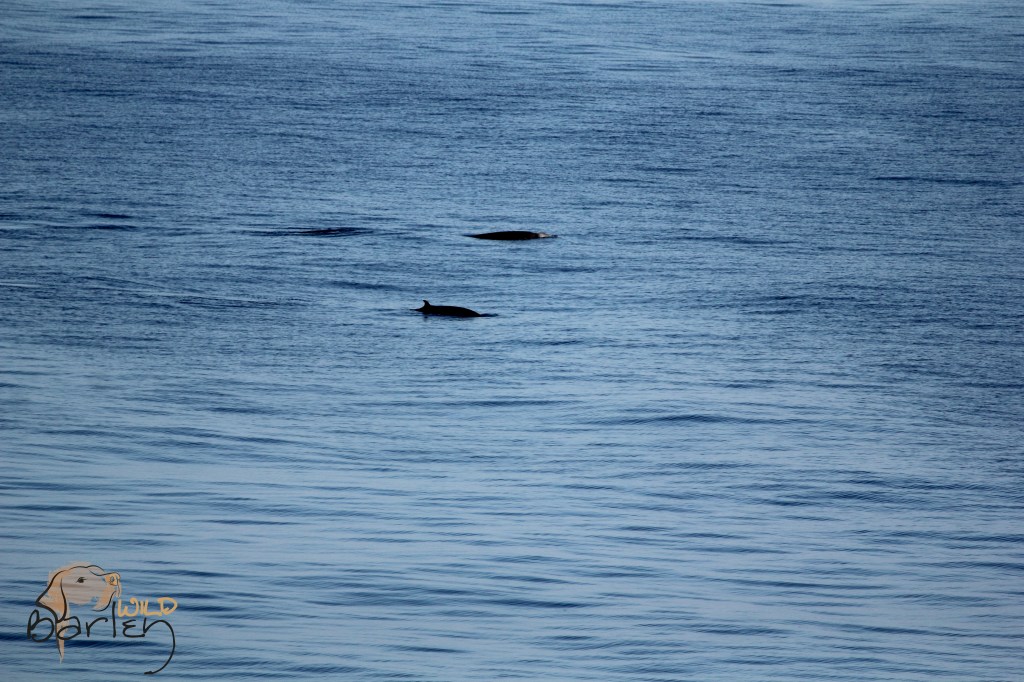
While the ferry route to northern Spain therefore passes over some of this prime habitat, spotting beaked whales still remains a challenge. Their surfacing behaviour tends to be elusive, and while they are recorded breaching or leaping clear of the water, most times they surface three, four times, and then disappear. In rougher conditions they can be nigh on impossible to detect.
But this time conditions were not rough. Following on from the calm serene conditions of the evening before in the English Channel, the conditions in the Bay were equally stunning. Calm, with just a few ripples, especially on leaving Santander for the return back to England, and with the sun on its final descent to bed. It was almost perfect. And with these calm waters came the beaked whale sightings. Individuals, pairs, small groups all passing alongside the vessel, and with the conditions calm enough we were picking them up far ahead of the vessel, which gave us time to get others onto them and importantly get good enough sightings to identify them. Most of the time.
A single whale, most likely a Cuvier’s surfaced on the port side. Then a group of at least three surfaced numerous times on the starboard side. This time showing the clear, brown bodies, and pale head of Cuvier’s. Then an adult and much smaller individual were sighted on the port side again. The small individual not really surfacing properly, in that it wasn’t really rolling through the water. An odd encounter that left us wondering. Three or four Cuvier’s Beaked Whale sightings in the space of an hour or so was not bad going!
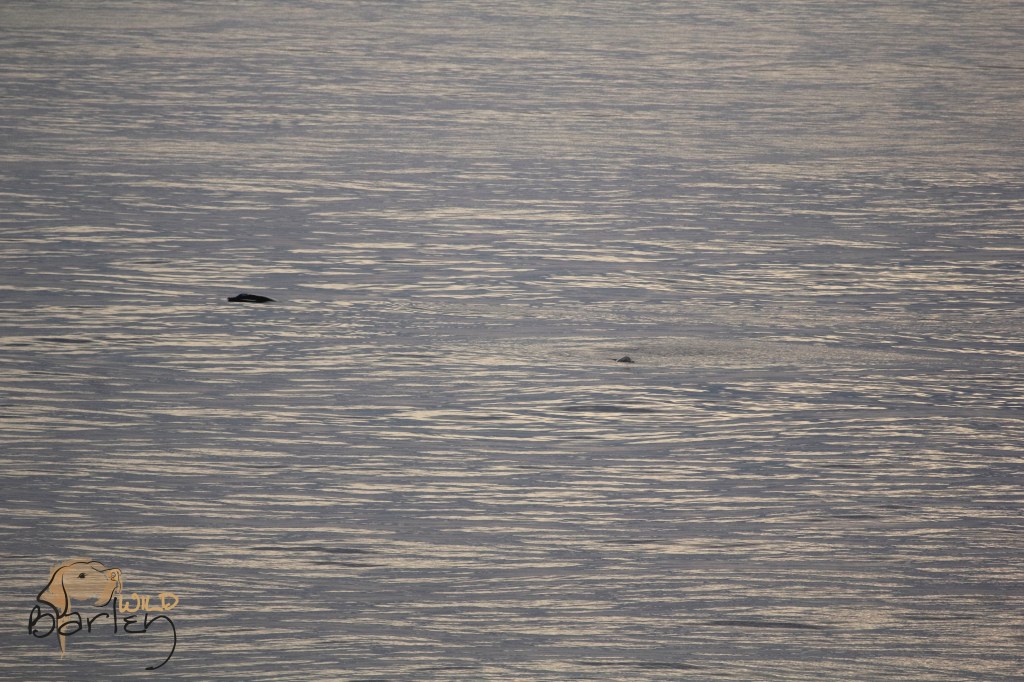
And then on the starboard side an animal surfaced. A beaked whale for sure. But which one. The light now was dropping, the golden molten water taking on shadows in the ripples, making objects appear darker, and wavelets appear like backs. But this was definitely a beaked whale. It surfaced numerous more times as the ferry passed, and the cameras clicked knowing that a photo may prove crucial for identification. Gut feeling for all of us on that deck was that this wasn’t Cuvier’s. It just felt too dark, there was no sign of a pale head. Once the animal had passed we huddled together zooming into pictures on the backs of cameras and discussions began. Names like Sowerby’s were thrown in. But for me it wasn’t. The beak was not long enough in the pictures and I had seen no sign of a long beak when watching the animal in real time. It is often described as a broom handle emerging from the water. But if it was not Sowerby’s or Cuvier’s then what? There were whispers of True’s. But I’m not one to make such bold statements unless I had irrefutable evidence and sadly my photos did not show that. Recorded as an unidentified beaked whale then, but with the promise photos would be looked at on a larger screen and sent to people with much more experience of identifying these whales.
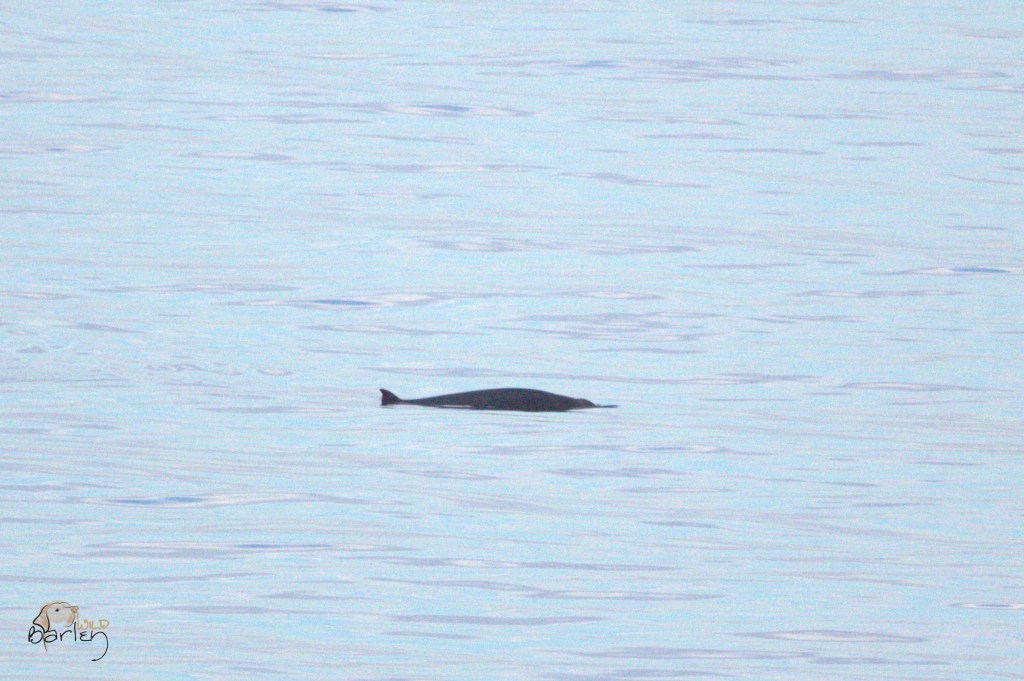
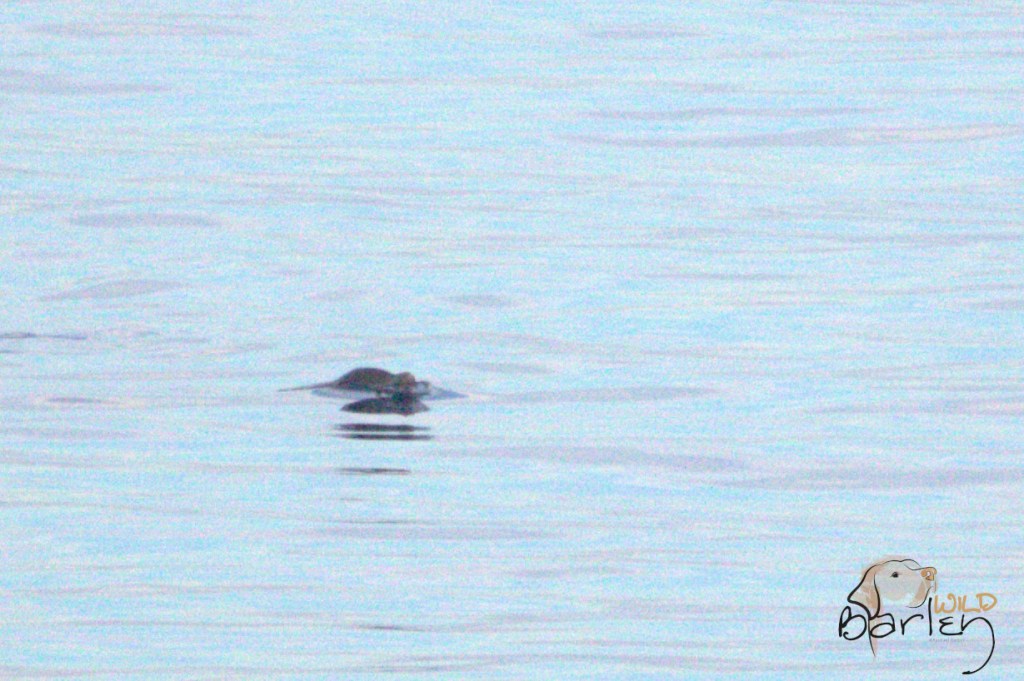
The sun set that evening over the tranquil waters of the Bay with our tally at 5 beaked whale encounters totally 7 individuals.
A few weeks later and verdict from the beaked whale experts was….
Unidentified beaked whale!
Interestingly though, the general consensus was that it was not a Cuvier’s. What follows in their thoughts and reasoning behind the different potential species:
Northern bottlenose whale – the square, large, bulbous head is not apparent in the photos and videos.
Cuvier’s beaked whale – the head and beak shape is not correct. Most Cuvier’s will exhibit the white face, although colour should be taken with a pinch of salt due to lighting and individuality, and have a gently sloping head. But this animal is showing a smallish, yet prominent melon with a small beak.
Sowerby’s beaked whale – the beak isn’t long enough for a Sowerby’s. Due to the long beak, the surfacing sequence of a Sowerby’s usually involves the beak clearly protruding out of the water, followed by the head and then a roll of the body.
Blainville’s beaked whale – there is no high-arched jawline. They do not have a pronounced melon which this animal does.
So then we have:
Gervais’ beaked whale – which it could be, although generally they do not have such a pronounced melon, so unlikely.
True’s beaked whale – which it could be as the animal exhibits a small yet pronounced melon and a small beak. The definitive identification would be the position of the teeth (on the tip of the beak), and that’s only possible if it was a male. Unfortunately no teeth can be clearly seen.
Then there is the possibility that it is another other beaked whales species, that has never, as yet, been recorded in the Bay of Biscay. Again though, teeth and their position are required for a positive ID.
So from the experience onboard and the photos, looked at by us and other beaked whale experts, we can say its most probably a Mesplodon (one of the genus of beaked whales) but we cannot say more than that. The encounter will forever stay as one of those many mysterious, unidentified, beaked whale sightings.
 Wild Barley
Wow! I have learned so much about whales from this post. Lovely photos too.
LikeLike