It’s been nearly eight months but I can still feel the heat of the Costa Rican sun. Still feel the gentle swell rolling the small, wooden blue boat. Still see that brilliant blue sky scudded with white clouds meeting the horizon and merging into the deeper blue of an ocean that changes to green closer to the shore, where the tangle of jungle runs to the edge of the water. I can still see the sunlight dazzling, gleaming and glinting on the water.

I can still feel the anticipation and hear the massive whoompf as the massive bulk of a whale surfaces a few hundred metres away. A huge plume of water is blasted into the air with each breath. In quick succession three or four whales surface, the sound of their breath being expelled lingers over the waves. Giant dark heads break through the waves, followed by a wide back that rolls away with a small humped dorsal fin, disappearing beneath the surface again. Occasional one lifts a tail, broad lobes, dark on the top and white, with varying patterns of dark splodges beneath, as individual as a human finger print, water dripping from the edges in a water fall that captures the light, glittering like thousands of diamonds.
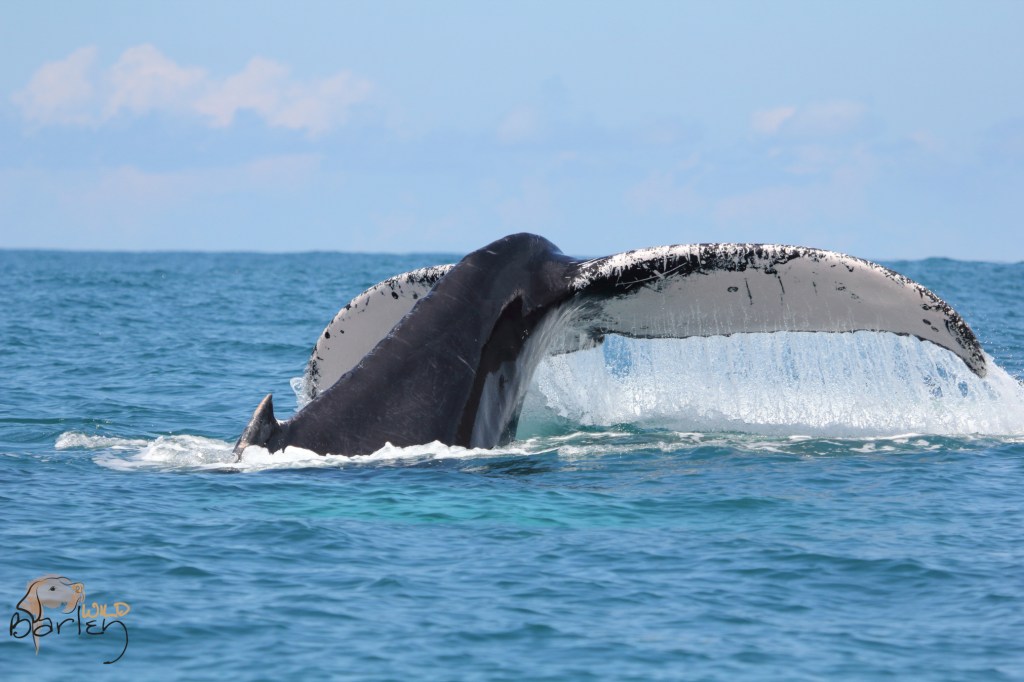
The whales are travelling, moving together, calmly, serenely, and we follow at a distance marvelling at the sight and sound of them. A short distance ahead of this group is another large individual, but next to it surfacing very close is a smaller whale. Its comparatively little head is followed by a shorter back, a nub of a dorsal fin. It is a baby, keeping close to mum.

The whales are all humpback whales. They come to the warm waters off Costa Rica to breed. The females, having fed extensively in colder waters of higher latitudes now goes hungry as she gives birth and nurses her baby. The other whales are male escorts, following the female, competing for a chance to mate with her.
Costa Rica is an incredible place for humpies. They are present pretty much year round, with both northern and southern hemisphere populations migrating here. In September it was the time for the population who spend the Austral summer in Antarctica and southern Chile to inhabit these nursery and mating grounds. They’ll stay for another couple of months before heading south again. From December humpback whales from the northern hemisphere will return to spend the winter here.
Suddenly the mood changes, switching from the calm, steady movements, to a charged, tense atmosphere. The escort males start throwing their massive bodies around, under and out of the water. 36 tons of bulk, muscle and blubber, thrust out of the waves, heads, bodies, tails, and flippers slamming against the water and each other. The heat run. The males compete to mate with the female, who much of the time is not having any of it especially if she has a little one in tow. At this point while she may be biologically available, she is more intent on protecting and nursing her calf. Most females have calves once every two to four years. Not that this seems to compute with the males. They thrash around, lunging, throwing proverbial punches. The water now explodes white around each surfacing, pouring off backs and tails in torrential waterfalls.

The raw power of it all leaves me speechless and in awe.
Its intense. Inspiring. Captivating. I’ve seen humpback whales before, but only on northern feeding grounds. I have watched them travelling, listened to them breath, making trumpeting sounds as they expel a breath into the summer air, watched them lunge open mouthed into a ball of fish, seen their tails lift against a background of pine forests and rocky shores. But there is something entirely different about watching males throw their bodies around and into each other under the blazing sun of central America. There is an intensity to watching this all play out with a young one in the mix, the mum manoeuvring her calf, protecting it from the melee. Its raw, emotional, exhilarating.

Finally things settle down again, the males tire of the female. The whales move off a little, mum and baby putting a bit more distance between themselves and the males. The males fall back, continuing their search for new females to approach. Things become calm again.
Its hot. Our guide suggests a swim to cool off. I’ve not got my swimming costume on but who cares. I jump into the warm blue salty water in my shorts and t-shirt. The deep blue disappears into darkness beneath my toes. I bob in the water grinning like a school girl, thinking that although many hundreds of metres away and I can’t actually see them, I am sharing the same water as those humpback whales. A thrill runs through me. Then our guide drops a hydrophone over the side of the boat, plugs it into a speaker and switches it on. Over the crackling and swirling sound of the water swishing around comes the distant, but oh so distinct sounds of humpback whale singing. My mind is blown.
If there is such a place as heaven on Earth then for me the Ocean is it.
 Wild Barley