We spent a day exploring the historic city of Stanley (yes it is a city) in the Falklands, under a brilliant blue sky and warm sun. We wandered past the wood-clad houses and other buildings, with earthly tones and bright coloured corrugated iron roofs, along the main street running parallel to the dark shoreline. A narrow stretch of dazzling blue sea met more treeless, grassy hills with rocky screes and slopes, coloured green, brown and grey on the other side. The few trees dotted in town all had a distinctive slant in direction courtesy of the prevailing winds. This day it was calm, the strong winds of the previous day having lulled, although by all accounts of the forecast it was to be a brief respite.
We passed gift shop after gift shop, selling Falklands wool garments, prints, artwork, and all the usual trinkets, adorned with penguins, whales and seals amongst the many designs.
We passed the main jetty unloading hundreds of tourists from the larger cruise ships anchored further off in the harbour. Pausing, we smiled at a pair of Southern sea lions basking at the end of one jetty, oblivious to the bustle going on around them.
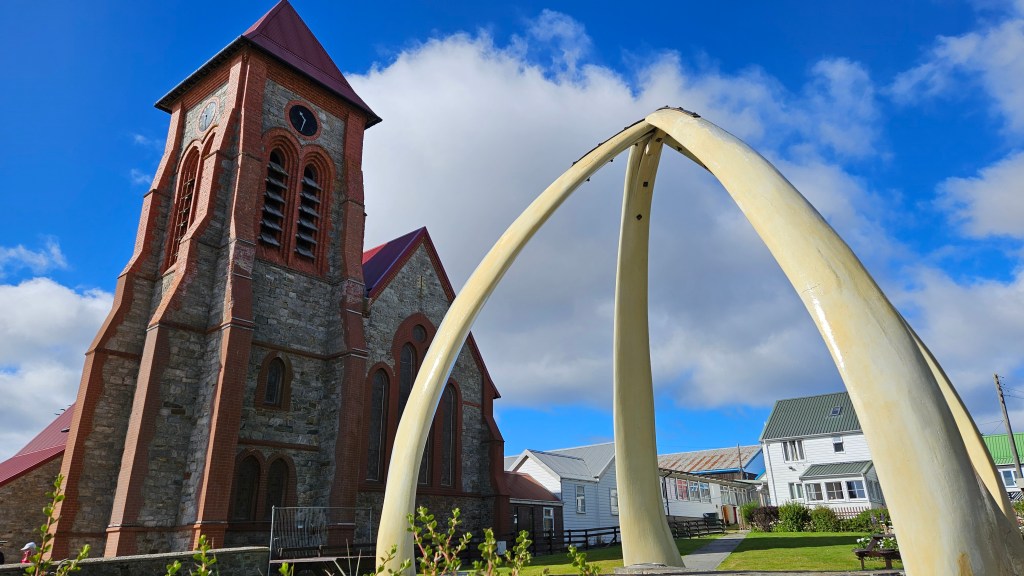
We explored the cathedral with its whale bone arch towering above you as you stand beneath, a stark visual reminder of the size of these animals. The arch is created from two blue whale jaw bones and was built in 1933 to commemorate 100 years of continuous British administration of the Falklands. We explore the museum soaking in the history of the city, islands and beyond, with exhibitions including Antarctic exploration.
It was a day to relax, explore and enjoy the glorious sunshine.
By evening the MS Fram was heading out of the harbour, leaving Stanley behind, passing the rugged coastline, with golden beaches and turquoise bays. Clouds had started to gather with an increasing wind, the forewarning of the storm predicted to arrive the following day. Golden light streamed through the breaks, highlighting the white caps that had started to form on the waves, changing the blue water to silver. Huge flocks of birds took off in one movement, sooty shearwaters with their silvery undersides flashing as they twisted and turned, skimming the water. A blow caught the light, tall and upright and a sei whale surfaced close to the MS Fram.
Slowly the ship continued to move away from the land, heading out to sea, but there was no rush.
Ahead more blows amongst the dark greyish blue waves. But these were different. They appeared V shaped and a little kernel of excitement began to blossom inside me. Nothing said yet to the large gathered group of passengers on deck. Patience was required. Waiting to get closer and check whether our suspicions were correct, and it was not just a figment of the strengthening wind. Closer still and they were distinctively V shaped and there was no doubt. Word went round the passengers. Southern right whales!
I’ll admit I did a little celebratory dance. A new species for me, and one I had really hoped to encounter while down here. The next 30 minutes was enough to blow the mind of even the most seasoned whale watcher.
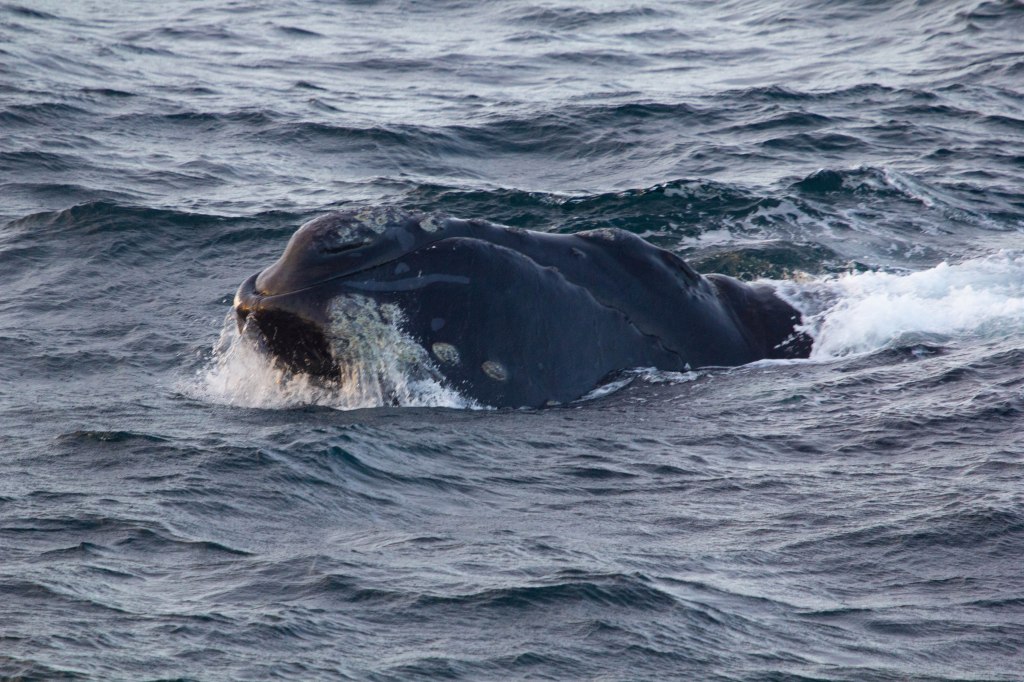
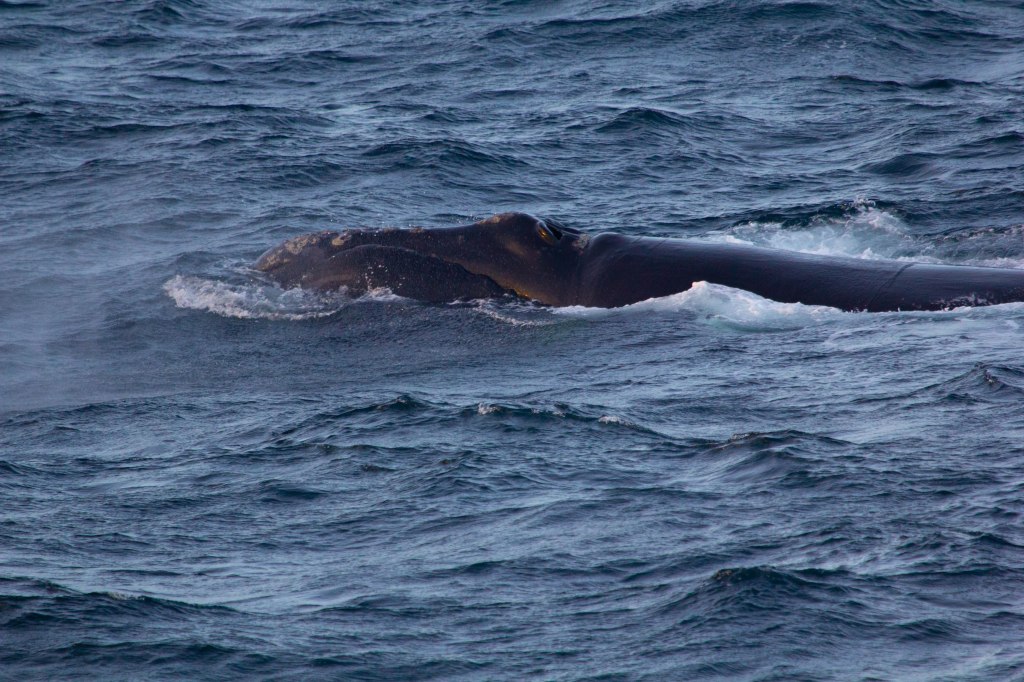
The Captain slowed the ship to almost a halt, bobbing gently in the swell, and two southern right whales simply milled off the bow. We watched in awe as these two whales, there is no doubt in my mind, watched us back. They lifted their unmistakable calloused heads out of the water, taking a good look, before splashing them down again, often making a trumpeting sound. There was the occasional pectoral wave and a couple of flukes, where the tail was lifted right out of the water. But mostly they appeared content to mill around at the surface, no place to go, no place to be other than right there.
Dusk was closing in as the ship started to slowly move away and the whales drifted further off, I still had to be pretty much dragged from the deck…
The southern right whale, along with its northern counterparts are an unusual looking whale. With dark grey skin, large, rounded body and no dorsal fin. Their heads are covered in unique calloused patches that form individual patterns and shapes on each whale. The mouth line is long and strongly arched.
So called the right whale because their habit of staying close to the coast, their slow surface feeding behaviour, high blubber content and rotund bodies which meant they floated when killed, made them the ‘right whale to hunt’. And hunted they were. In the Southern Ocean alone, nearly 60,000 were killed and the species was almost driven to extinction. Recovery in the Southern Ocean has been better, where the population now stands at between 10,000 and 13,600 individuals, although they are still highly vulnerable especially to vessel strikes. In the northern hemisphere the story is not so positive, with only 300 or so individuals left in the North Atlantic population and fewer than 500 in the North Pacific population.
But sitting here, recalling that incredible encounter got me thinking, if they were not called right whales, what name would I give them? What name would suit them that didn’t symbolise their violent history but symbolised something about their appearance or habitat or behaviour. So I did what any good researcher does these days and googled it…
Local and historical names that came up included:
Black whale used by early North American colonists, makes sense with their dark skin…
Nordcaper, a Dutch term meaning ‘the whale from Norway’s North Cape’…
Sletbag, an Icelandic name translating to ‘the smooth-backed whale’, again makes sense given their lack of dorsal fin…
Rocknose whale, an old colonial American whaler term, seemingly referring to the rock like callosities on their heads…
Seven-foot-bone whale, an historical term referring to their long baleen plates…
So what would I call them? Maybe Callous-headed whale? Not much of a ring to it… Or rough-headed whale? Or rough-nosed whale?
Or drop-jaw whale as suggested by my husband in reference to their high curved jawline…
What do you think?

