The ocean was a maelstrom of white and deep blue. The wind whipping waves that rumbled and tumbled over in a rush of foaming water, the troughs between hidden from view. We stood on the bow of the MS Fram, a few sheltered spots providing some respite from the rampant wind. The sun continued to blaze in a brilliant blue sky, the horizon hazy. The ship weaved a path between islands and headlands of the Falklands, leaving the windswept New Island and its albatross and heading for Carcass Island.
The seabirds followed, loving the wind, letting it catch their wings and push them up and over the waves, before dropping and skimming the water effortlessly with their wing tips. Black-browed albatross, sooty and great shearwaters, prions and giant petrels all in their element.
From the waves Peale’s dolphins surged towards the bow of the ship. A brief surf, swirling through the spray before disappearing again. Yes, I did film it. And yes, in my excitement I flipped the camera and filmed my face instead of the dolphins….
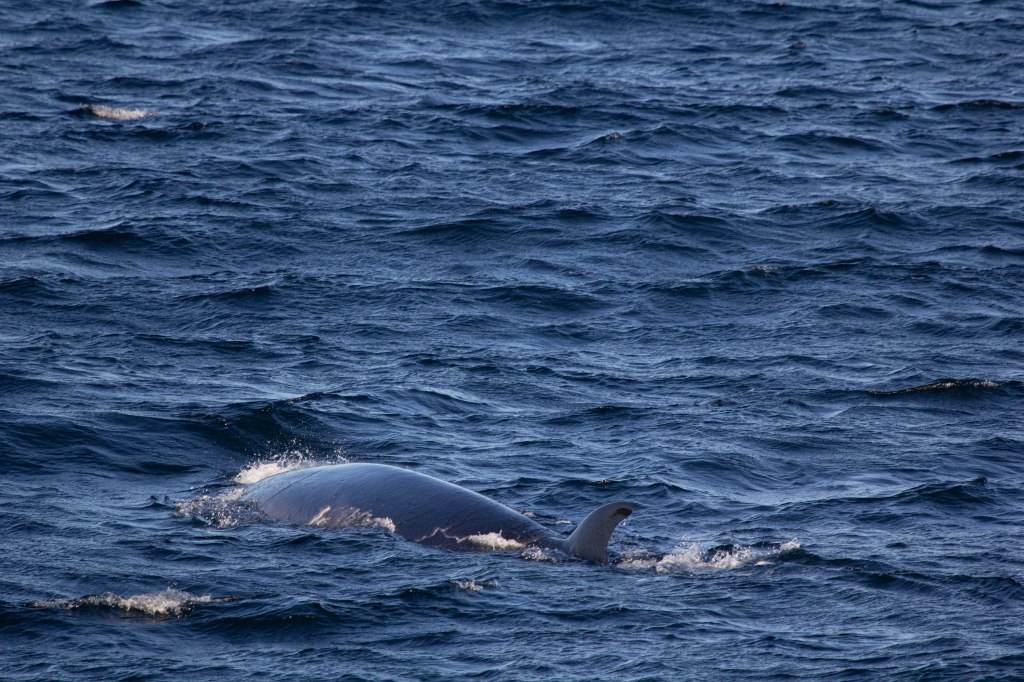
But it was not just dolphins that appeared. The forceful exhalation of whale’s breath appeared as tall columns of condensed spray that was quickly taken away by the wind. It was hard to pick out the body of the animals within the troughs of the waves, but a couple of individuals surfaced closer to the ship and we were able to see a long dark back and tall upright dorsal fin giving the identity of these whales away, sei whales.
The ship traversed through a narrow channel between islands and something porpoising out of the water caught the eye. But it was not the usual suspects, seals or dolphins, but penguins! Hoards to gentoo penguins bursting rhythmically out of the water in bands of 10 or 15 birds at a time.
As we approached Carcass Island we had one final close encounter with a sei whale, giving great views among golden sunlight, that caught like glittering jewels the spray from whale and waves alike.
The landing at Carcass Island was a wide swept bay with a rocky shore that met the same treeless tussocky grass landscape that swept up to hills beyond. The beach was white, with large beds of dark rock pools exposed by the tide and covered in a patchwork of kelp. Directly opposite where the zodiac deposited us on the beach was a small wooden slatted house, nestled within a wood of tall trees, the first we had seen all day. The trees, branches, leaves and grass all swayed in the ever present breeze.
We walked around the curve of the bay, the path lifting away from the rocky beach, so that you looked down onto its shore where steamer ducks, geese and one or two Magellanic penguin sat among the rocks. Heading in the direction of the old stone slipway, we passed bits of tangled scrub and bushes lining the path. This time it was a small passerine that stole the show. Amongst the twisted and intertwined branches came the call of a classic LBJ. Little Brown Job. The challenge was to find the bird itself as it scurried through the thicket. Briefly it darted onto the top of an outer branch and what appeared was a small, round brown fluffball, with a dark curved beak and short sticky up tail. A Cobb’s wren.

Once more I could be at home, although there are subtle differences between this and the Eurasian wren. The Cobb’s wren is endemic to the Falklands, which means it is found no where else in the world.
So while most of the passengers were focussed on the scenery, or the penguins, or the bright and colourful long-tailed meadowlark (though give it credit that is a very beautiful bird!) a small group, me included, was enamoured with this small brown job and what a privilege it was to see.
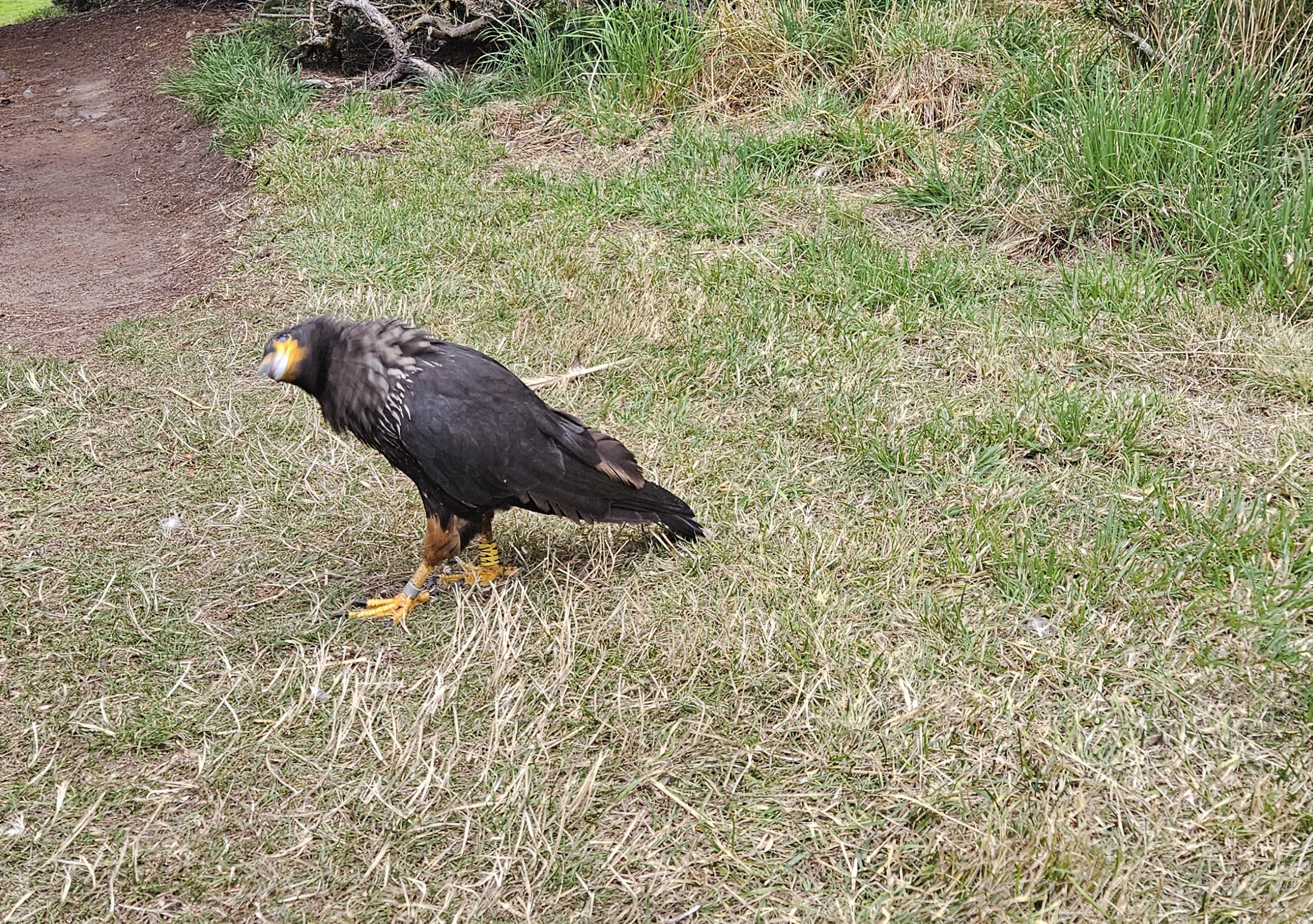
The other bird to steal the show at Carcass was once again the striated caracaras, also know as the Johnny Rook. As at New Island, they were bold, brazen and not bothered by people. They watched everyone’s movement, waiting for any opportunity to scavenge, hopping along the ground, dancing around people’s legs. While so bold and brazen as perhaps to be overlooked by people, the striated caracara is in fact a rare, near threatened species. They are striking, chocolate brown with dark intelligent eyes. The adults have golden faces and silver streaking on the neck. And they are super intelligent, inquisitive and often mischievous. A member of the falcon family, this bird of prey is more likely to be seen running around on the ground than perching. With an insatiable desire to investigate the world around them, these smart birds are known to use their feet to and beaks to manipulate items and turn over rocks in search of food.

One individual caught my attention as it was wearing a yellow colour ring. I took the quickest snap on my phone, as the call had come for all passengers to return to the ship and we had to leave. The wind and swell was picking up and it was time for everyone to return to the MS Fram.
The zodiac trip back to the ship was more adventurous. The little boat rolled over the waves, spray splashing over its inhabitants. It bobbed and rolled as we waited our turn to return to the MS Fram, which sat stoically, unmoving. The wonders of Dynamic Positioning. It was not long before we are back in her warm, steady embrace and as night fell she headed out into the rolling sea for our next destination, the most famous place in the Falklands, Stanley.
Back home I tried to do some digging on the striated caracara that I saw, emailing the Johnny Rook project and notifying Falklands Conservation in the hope of finding out more about this individual bird. As yet I still await news, but most of the birds colour ringed as part of the monitoring project are done so on Saunders Island, so it may not have travelled far.
 Wild Barley