Morning dawned bright, sunny and breezy over a landscape unerringly familiar despite being at the other end of the planet. A rugged wind swept, treeless landscape, a dark rocky shore and white sandy beaches, with brownish green grass meeting a brilliant green and blue sea. I could be in the northern isles of Scotland and yet I was in fact on New Island, one of the Falkland Islands. The calm of the previous days weather was replaced with a strong wind whipping the sea into startingly white crests over the deep blue. Even with the wind, white caps and waves, I see the blows of whales through my cabin window.
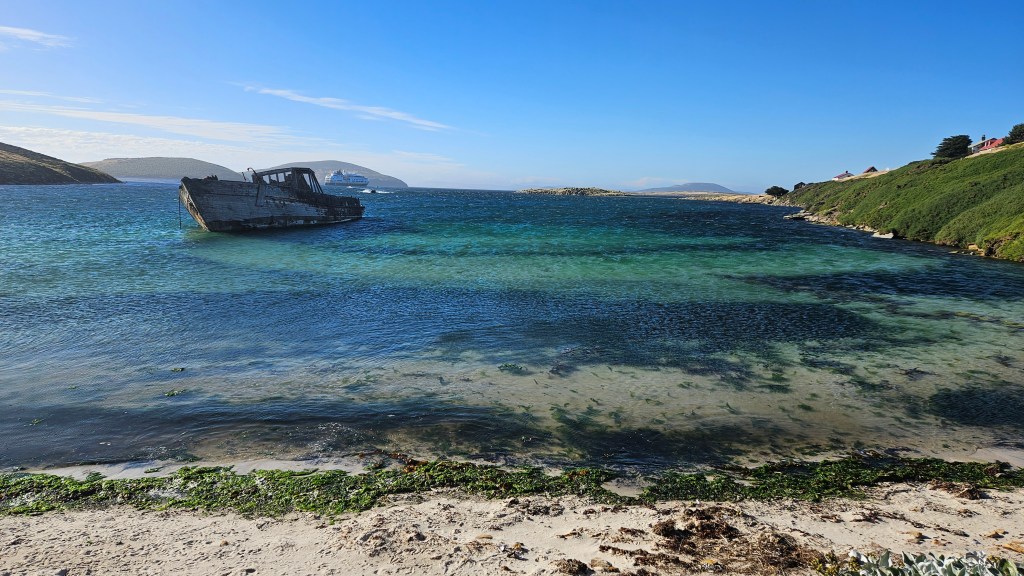
The Fram was then positioned just off a little bay, the bones of a ship wreck in its centre, a small stone building with a red roof nestled into bank at the back of a small white sand beach at its head. The water was sheltered and calm, a patchwork of brilliant turquoise and deep blue as the sandy bottom gave way to beds of kelp. The white beach has ribbons of green and brown seaweed washed up, before the sand gives way to tall pale yellow grasses, heads bowed with seeds bobbing in the breeze. A small stream wends its way through the grassy moor beyond the beach, trickling into the sand and then sea. At its mouth a cluster of crested ducks, Falkland steamer ducks and kelp geese dabble in the water or sleep curled in on themselves in the grass.
Beyond the building, which is a small museum, a brown dusty path leads away through tussock grass that slopes up gently on either side, rising to low rounded peaks and cliffs above. Making our way up this path, the wicked wind is relentless and whips up the dusty soil, flinging it right into the eyes, but it is well worth the push through. Upland geese graze in the longer grass to the sides of the path or fly low over us in pairs, with a high pitched whistling ‘wheep’ and ‘whee-o’. The males are handsome birds with white heads, necks and fronts, and black barring on the back and flanks, the females are just as beautiful with rusty red on the head and neck. Striated caracaras, bold and brazen, fearlessly swoop over our heads, landing mere feet away to watch our every move.
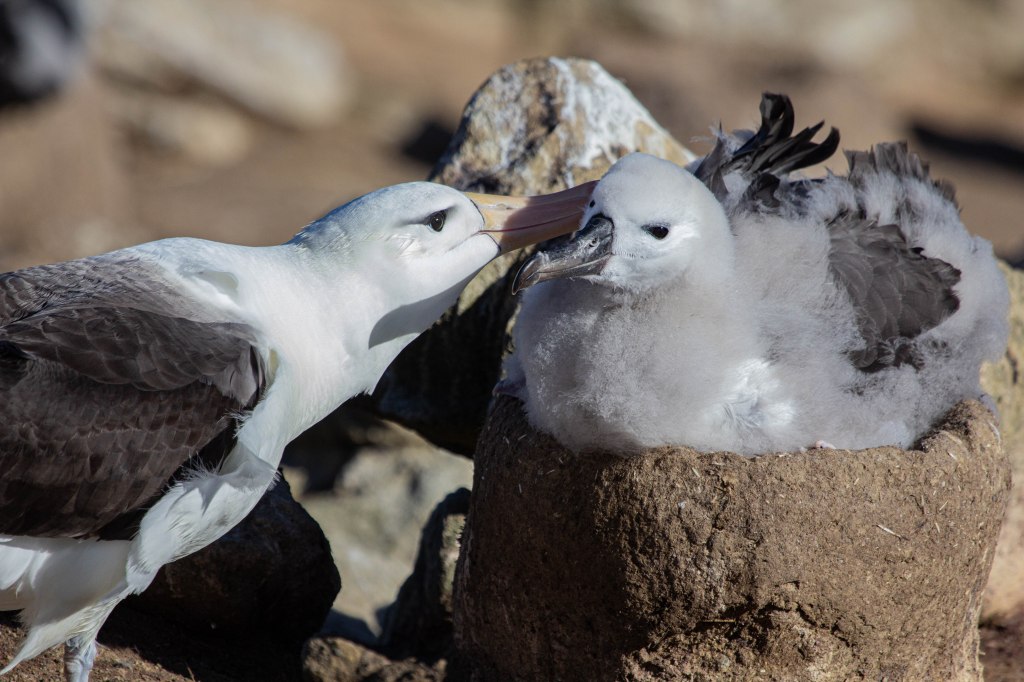
The path leads into the wind and to a cliff edge that is a bustle of seabirds. Amongst the boulders at the edge of the cliff and in the nooks and crevices down its steep face, hundreds of Imperial shags and black-browed albatross are closely packed in together. A few albatross chicks remain, fluffy grey bundles perched on a small pillar of a nest raised above the ground. Adult black-browed albatross soar overhead through the blue cloudless sky, buffeted by the wind as they swoop round or come into land. Beyond the sea is a maelstrom of white water over a deep blue. Occasionally an adult albatross lands, regurgitating some food into the mouth of its young, giving it an affectionate preen before lifting off into the wind again. Brown skuas dive in, searching for food to steal, and alongside the caracaras cause squabbles to break out amongst the shags. The sound is raucous, the smell as relentless as the wind. Down below in the gully between the cliffs, rockhopper penguins sit on flat bits of rock, looking rather sullen in their moult.
The wind buffets us as we stand atop looking over this seabird city, an assault on the senses, from the sight, sound and smell of some many birds to the physical battering of a relentless wind. Its seabird heaven.
New Island is renowned for its breeding colony of black-browed albatross, and while its not the largest colony in the world, it still holds nearly 10% of the entire Falklands population with more than 13,000 pairs on the island. Black-browed albatross pair for life and return to the same pot-shaped nest each year from the age of 7 to breed. This beautiful seabird can live up to 70 years old and spends most of its time gliding over the waves of the open ocean, only returning to solid land to breed.
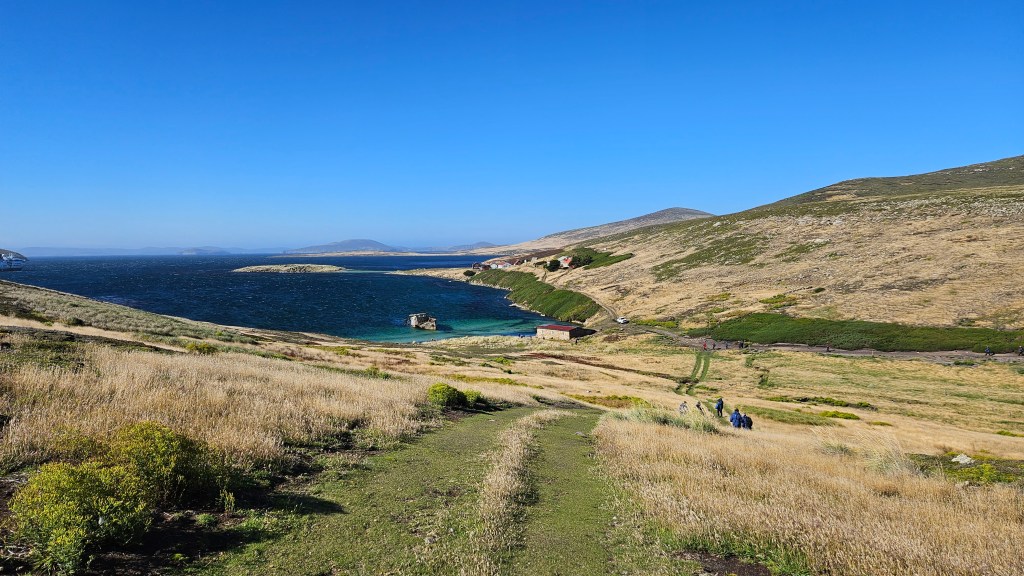
When we had our fill, it was time to head back to the landing site, now with the wind pushing us along into our backs as we walk along the path through the tussock grass. There was one last climb up the slope of one hill that gave a panoramic view of the landing site, the Fram and the hills beyond. Then it was back to the boats to be taken back to the Fram and on to our next destination…
 Wild Barley