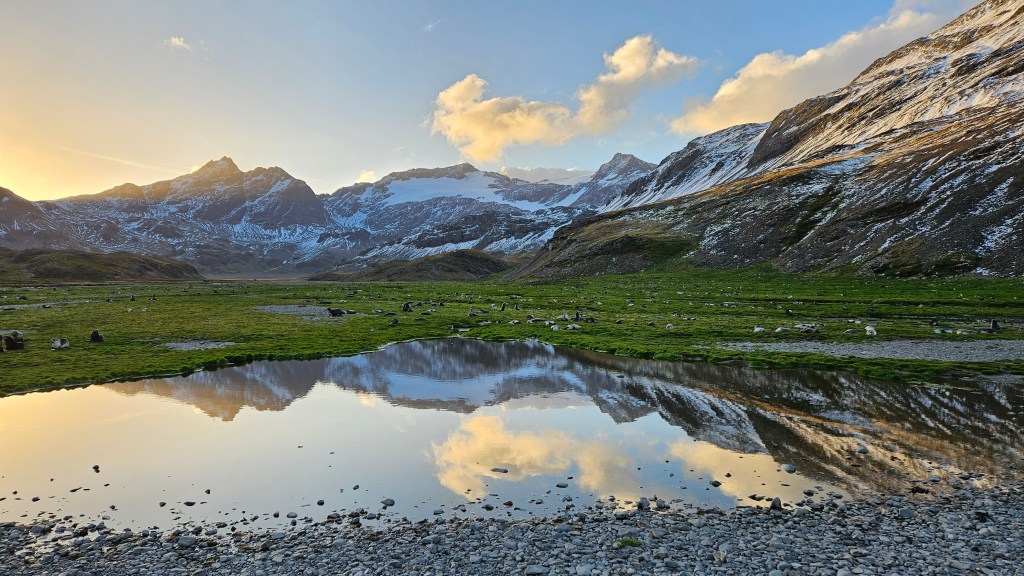
The landings in South Georgia were epic. Filled with breathtaking scenery, from stunning rugged peaks, immense sweeping glaciers and ice walls to fields of tussock grass, dark pebbly beaches and water that was on occasion brilliant turquoise blue or steely grey. All filled with wildlife. It’s hard to believe if you have read the previous post about the king penguins that this was not the most numerous species of wildlife that we encountered on these landings. That honour sits firmly with the seals, well for all except Gold Harbour perhaps, but even there the seals rivalled the spectacle of thousands of king penguins if not in number but in sheer bulk.
Most numerous of the seals during March were Antarctic fur seals. It was not the dense beaches full of breeding males or tiny pups, but still young seals of the year frolicked in the surf, riding any waves, tumbling over each other, running up and down the beach. Pup by name and puppies by nature. They would gamble up to you, barking, grumbling and yelping, curious, playful and maybe with more than a bit of bravado. It’s why you always walked in pairs, so someone had your back and why you always took a walking stick with you on any landing. A strategically placed stick in front of a pup literally stopped them in their tracks, only for them to start nosing, mouthing and chewing the stick!
Older seals, including some females, snoozed along the beaches, in the tussock grass, amongst the old whaling stations and paraphernalia, and even on the graves at Grytviken. Basically, all over the shop, so that you had to be careful wherever you walked.
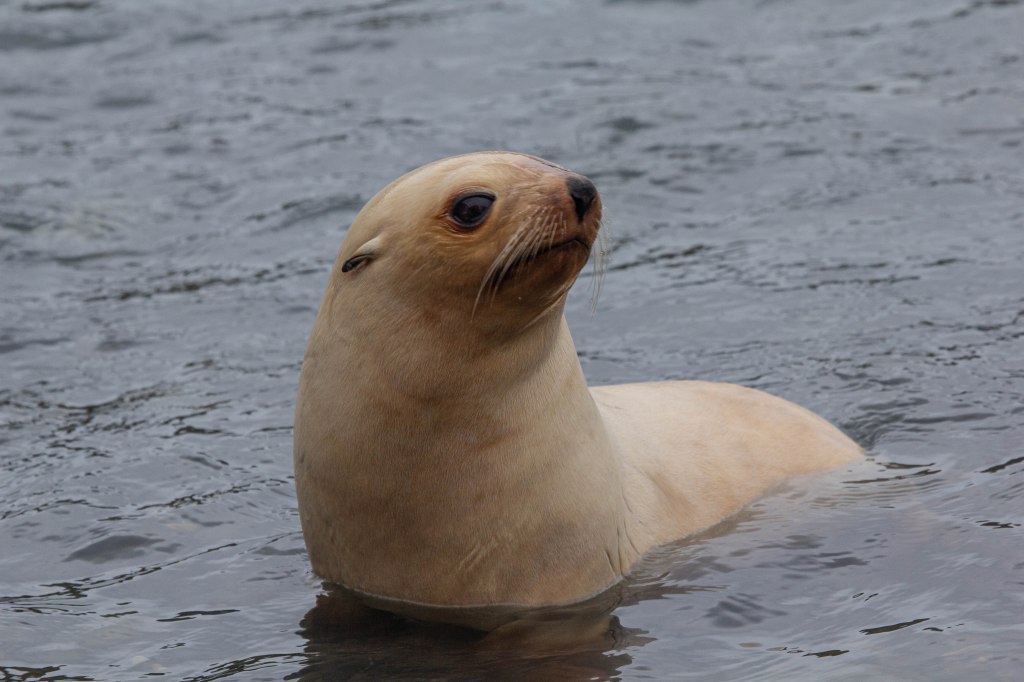
They were a complete joy to watch, tumbling and rolling over each other. Most were dark silvery grey or brown, but there were a couple of blondies, contrasting with their pale-yellow fur. About one in every 1000 pups are born blond, caused by the partial loss or reduction in melanin, known as leucism. They are particularly seen around South Georgia, since 95% of the population breeds here, with the high density along with the historical bottleneck when the species was almost hunted to extinction, creating low genetic diversity and meaning they are more commonly spotted here.
While they are quick on land, they are super speedy in water, torpedoing out of the waves, leaping like dolphins alongside the boats.
It’s hard to believe that within 50 years of being discovered by Captain Cook, ‘sea bears’ as he called them were hunted to oblivion and were almost extinct, with 1.2 million seals killed for their pelts. A handful survived and through stewardship, protection and conservation measures, numbers have rebounded with 3.5 to 5 million now on the island. It is a quite astonishing, very visible sign of South Georgia’s recovery and the ultimate comeback story.
But could there be a sting in this tale? In April 2026 Antarctic fur seal were relisted from Least Concern to Endangered on the IUCN Red List, mainly as a result of the population of mature individuals decreasing by more than 50% in recent years. The decline is due, among other things, to climate change, with rising sea temperatures and shrinking sea ice pushing krill to deeper depths making it scarce for nursing mothers and pups.
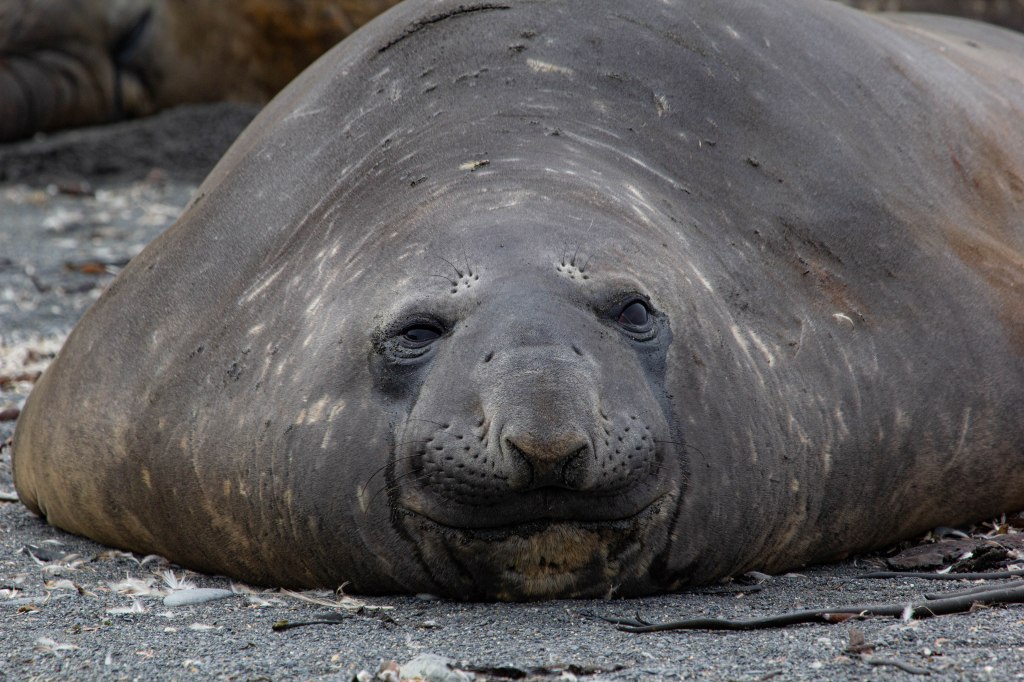
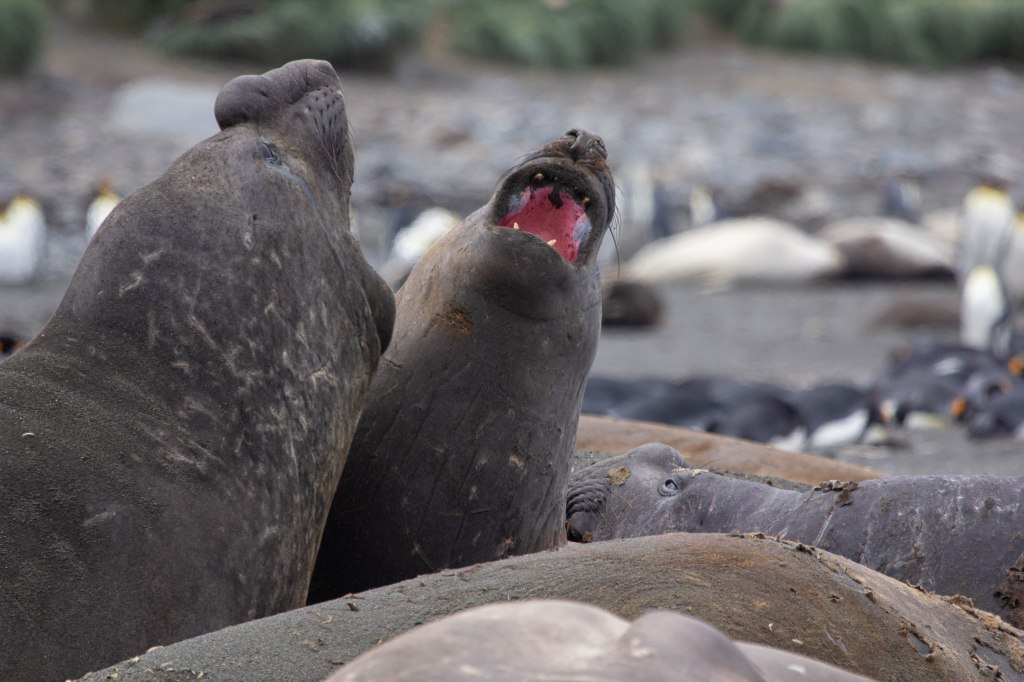
The other seal we encountered in South Georgia is the largest of them all, the southern elephant seal. At Gold Harbour in particular there was a huge pile of them, massive blobs wallowing together on the beach and at the edge of the tussock, the occasional individual or pair resting away from the heap. Compared to other times of year it was a rather calm and serene scene, with none of the huge beachmasters aggressively dominating the beach and no young weaners to be caught in the fray. The adults here were in moult, their coats patchy and scruffy in places. Mostly they lay, farting and burping in one heap, occasionally a couple of younger males would raise up to argue and bellow at each other, practicing for what will come, but its all bluff and gumph at this stage, and they soon settled back down. While it was not the spectacle of beachmasters jostling and fighting over harems of females, they were nonetheless a formidable sight especially amongst all the king penguins.
Like fur seals, elephant seals were heavily exploited, with an estimated 800,000 to over 1 million seals killed, and as with the fur seals, international protection and conservation measures have resulted in many populations rebounding. But like the fur seals, recent times have brought declines, with southern elephant seals being moved from Least Concern to Vulnerable in April 2026. This time it is the menace of bird flu that is causing significant declines, with the disease particularly hitting hard those species that live close together in dense colonies like southern elephant seals. That in addition to the polar regions not having much previous exposure to pathogens, means that since its arrival in the region, bird flu has killed more than 90% of newborn elephant seal pups in some colonies and is having a serious impact on adult females, who tend to spend more time on beaches compared to males.
Despite these concerns, and probably all the more for them, watching those seals on those remote beaches surrounded by that epic landscape was an awe inspiring and humbling experience.