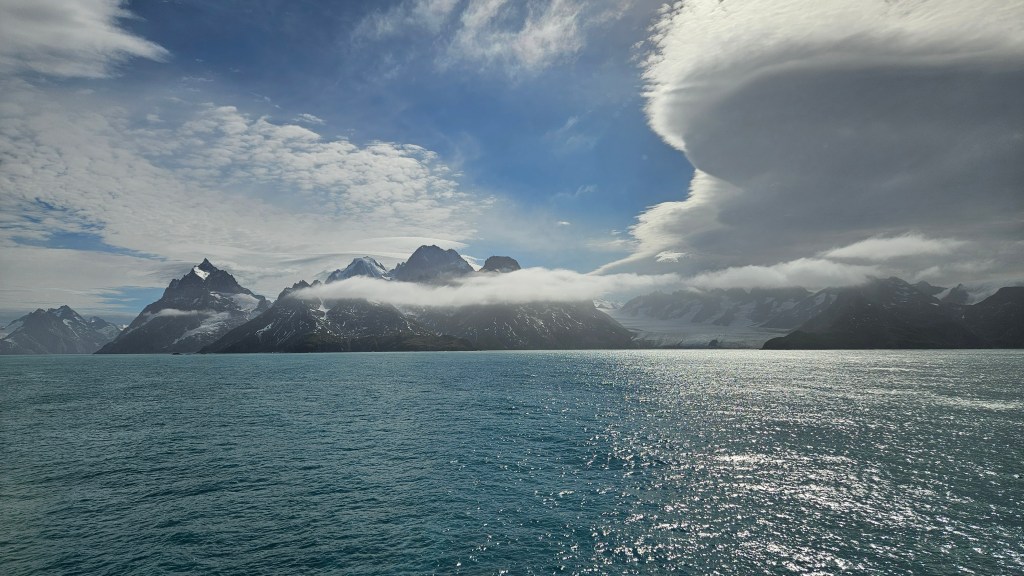
Between those incredible landings in South Georgia, with its immense landscape and breathtaking wildlife, we surveyed the ocean around the island from the bridge of the MS Fram. Scanning waters that changed from deep blue to turquoise to grey depending on the ever-changing mood of the sky and wind. We encountered fog, mist, rain, snow, sleet and intense sunshine, sometimes all in the same moment.
The ocean around South Georgia has seen an incredible recovery in whale populations. Once the epicentre of whaling in the Southern Ocean, whale populations were decimated to near extinction, reduced to mere fractions of their original size. Between 1904 and 1965 over 175,000 whales were killed, first southern right whales, then humpbacks, fin and blue whale. With the collapse of the industry, the moratorium on whaling in 1986 and numerous conservation measures including those around South Georgia, some whale populations have begun to recover. In the case of humpbacks and fin whale numbers around South Georgia have increased dramatically, with more sightings and in the case of humpbacks larger group sizes. Southern right whale too has seen steady population recovery. While the story of recovery for blue whales is perhaps less dramatic, records of this the most magnificent and largest of all the whales, have increased from around South Georgia and during a trip earlier in the year, from this very ship an Antarctic blue whale was successfully matched across years. An exciting conservation story hinting at possible regional fidelity of blue whales i.e., that at least some blue whales are using South Georgia as a repeat destination and not just passing through as ‘one-off’ circumpolar visitors.
The vessel and expedition crew, ORCA scientists and other guest scientists, all tell stories of immense encounters with large numbers of whales around South Georgia. Of navigating around hundreds of whales. It was then with anticipation and excitement we headed onto the bridge during each transit…
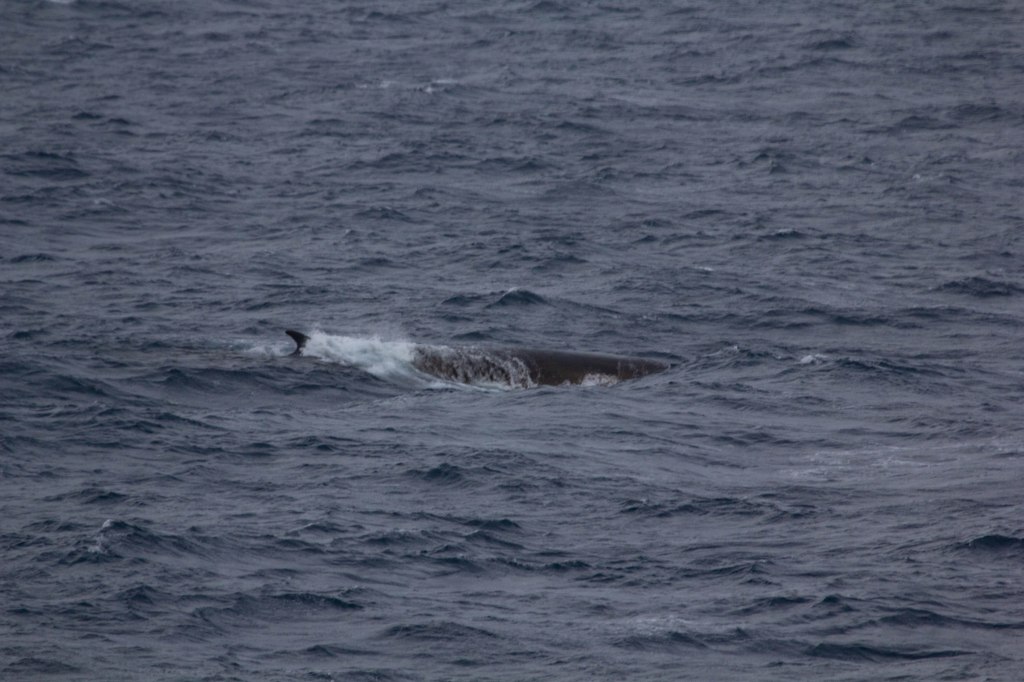
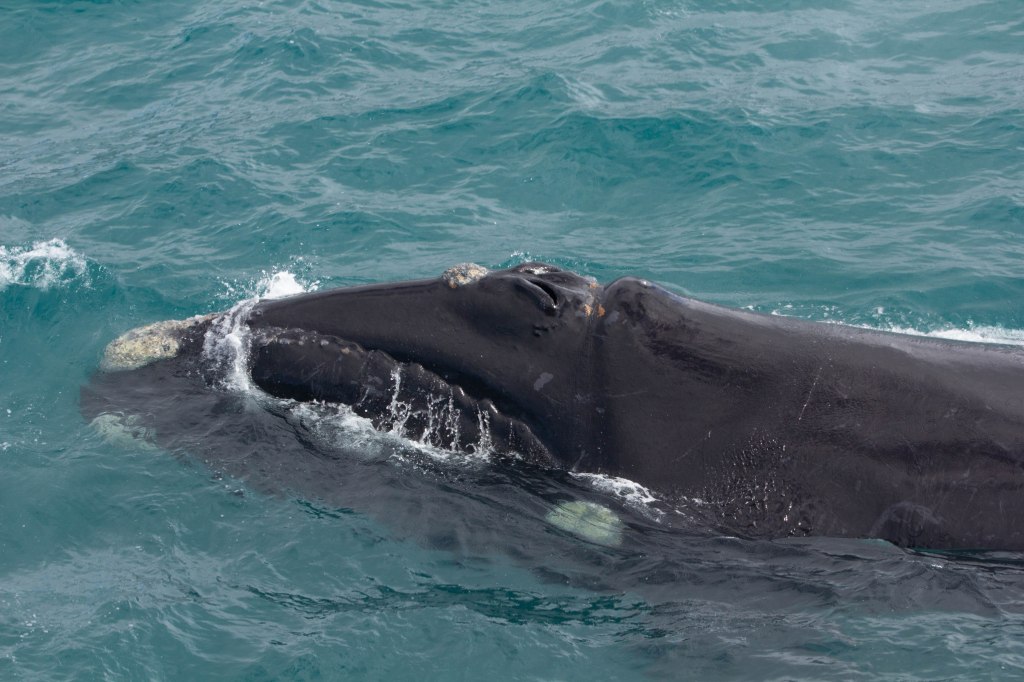
For us, in March 2026, South Georgia’s waters were relatively quiet in terms of whales. We had a wonderful encounter with two southern right whales close to the ship; sightings of distant large blows and one closer encounter with a sleek fin whale. But no humpback whales, leading us to wonder where were they?
The answer came from communications with other research vessels in the region. As the MS Fram left South Georgia and headed south, with the waters of Antarctica waiting, we received an email from a research vessel monitoring the krill fishery. The fishing boats, and the whales, were further south with large numbers currently reported off the north coast of the South Orkney Islands.
The MS Fram steamed southwest from South Georgia heading for the South Orkneys, standing out on deck and there was even more of a nip in the air and, excitingly, there were blows on the horizon. Four or five whales glimpsed before fog rolled in. Patience was the name of the game. But for the rest of that sea day the fog remained stubbornly close obscuring any more whale blows. She kept steaming aiming to stay ahead of a storm closing in behind, the Captains reassurance of ‘we’ll look to hide from it’ greeted with rather a bemused ‘where are we hiding in the open ocean?!’ The answer was to get to the South Orkneys as quick as possible and seek shelter between the islands as the storm passed through.
It was an interesting night. We were warned to place our belongings on the floor of the cabins to prevent them falling off and being damaged. It didn’t feel like the ship actually moved a huge amount, no climbing large waves and falling into deep troughs, although she rolled sideways quite a bit. The wind however was ferocious, roaring against the ship, rattling, shaking and shuddering against her. I could hear the engines working hard against the wind and waves. We reached shelter for the worst part of the storm, although not the spot the Captain had been aiming for with a huge iceberg occupying that spot. We spent the night with the anchor out and the MS Fram manoeuvring around it. A relatively comfortable night for the passengers but no doubt one of high alert for the Bridge crew. At its peak gusts of 90 knots had battered the ship.
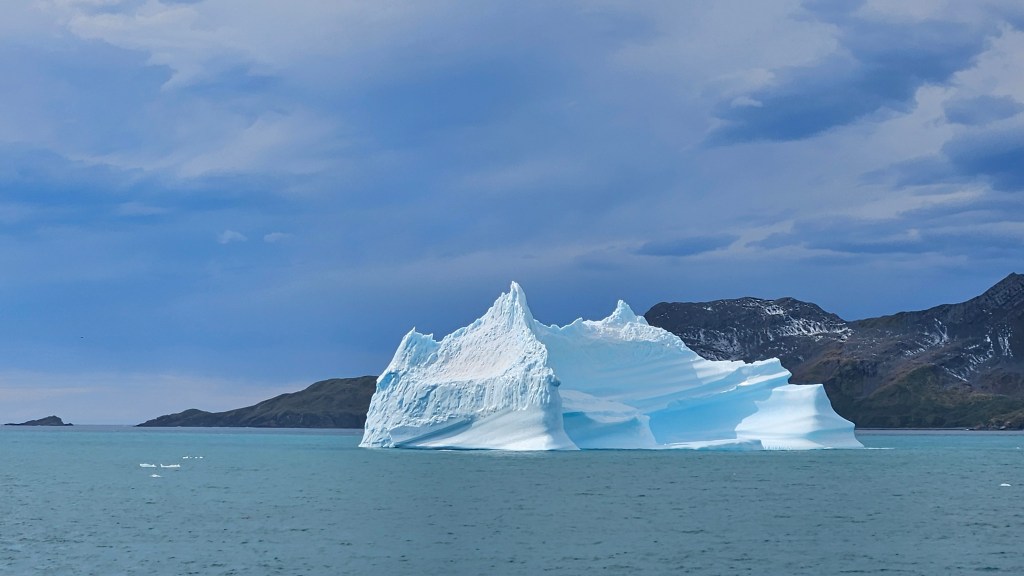
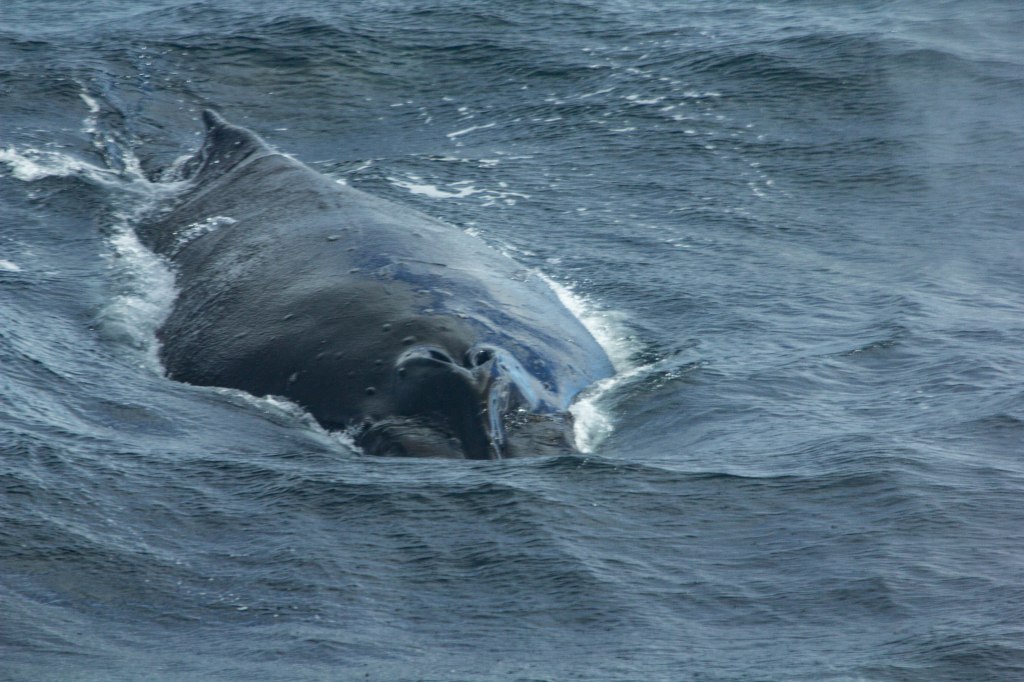
We awoke in the morning to stormy and windy conditions, and our first glimpse of an Antarctic Island. Huge dark mountains with rivers of glaciers flowing between them, Coronation Island, with more distant peaks of Laurie Island to the other side. And in between icebergs of all shapes and sizes. The wind continued to whip the ocean into a frenzy of white water and waves that crashed against the base of these bergs sending more spray into the air. Sculptured shapes with smooth snowy white slopes and sides, indented with crevasses, caves and cracks of an astonishing cobalt blue. And amongst the waves, white caps and spray… whales. At least four humpback whales feeding around the ship, negotiating their way around the bergs, lifting their flukes to disappear under the tempest once more, reappearing closer and then further away. In the distance, amongst the towering ice, more whale blows. We had caught up with the whales.
We spent the morning watching the whales from behind the protective screen, with all other decks understandably closed off. Still, it was more than enough to see these incredible whales as they worked the water around us.
Once the wind had dropped further, we headed for the British Antarctic Survey station on Signy. A relatively short hop around, but the dreaded mist had descended, and any surveying was cut short. All we could do was watch the ghostly shapes of icebergs as they appeared and then disappeared around us. On arrival to Signy the mist lifted revealing the magnificent Coronation Island bathed in glorious sunshine, gleaming brilliant white, its uncovered slopes deep dark black. The stretch of water between filled with more giant icebergs in all their wonderful shapes. The rest of the afternoon was spent visiting the BAS station and getting a glimpse into what it might be like to live and work in this incredible place.
With darkness drawing its curtain on the mountains and icebergs, the MS Fram turned her bow once more south.
First another sea day. Another opportunity for survey. Another morning with the ocean covered in a dense blanket of fog. More patience required.
With the lifting of the fog came almost immediately the call of ‘sighting’ from the survey team, the blows of large whales now visible. The sea remained choppy with a swell that more often hid the body of these whales, but some closer encounters revealed the long body and swept back dorsal fin of most likely fin whales. It was a great day surveying, a relief to catch up with whales while on survey, adding more valuable data on these recovering populations, all topped off with the tingle of anticipation and excitement that we were getting closer to the Antarctic Peninsula and her islands….