Antarctica, that realm of untouched, unparalleled wilderness, beauty and unique wildlife. For so long the realm only of bold explorers who faced extreme conditions, being the first to touch and lay eyes on this stunning landscape. Names like Cook, Ross, Amundsen, Scott, Shackleton, Wild and Cherry-Garrad, to name only a very few and by no means all of them. It is every wildlife watcher and explorer’s dream, me included. In fact, in August 2016, I wrote a blog call ‘An Antarctic Dream’ where I imagined what it would be like to visit this frozen wilderness. There I wrote of towering icebergs, black mountains covered in ice and snow, the sight, sound and smell of thousands of penguins, of tranquil seas and tempestuous oceans. Of whales and seals, penguins and albatrosses. All dreams. All in the hope one day I might visit it for real.
Tourism to Antarctica began in the 1950s and has grown exponentially since. These days anywhere from 70 to 100 or so vessels visit the region every year bringing thousands of visitors to the frozen continent, predominantly to the Antarctic Peninsula. The increase in tourism vessels has also brought an opportunity for research and environmental awareness. The opportunity to take guest scientists on board studying everything from kelp, to penguins, whales to plankton, is now facilitated by a number of expedition companies.
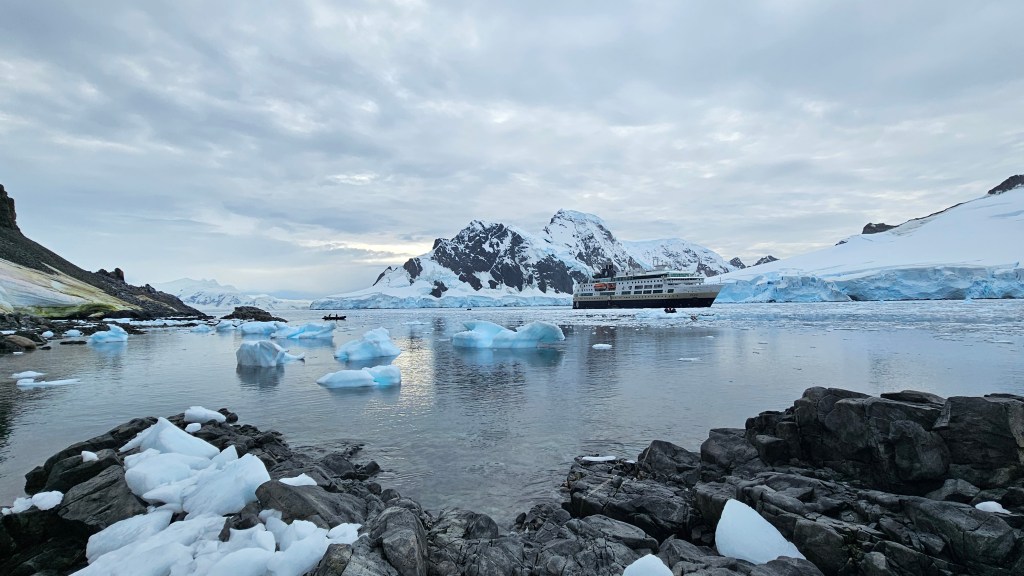
In 2022 the marine charity ORCA (Organisation Cetacea) was tasked with setting up a bespoke research project using distance sampling to monitor the recovery of large whales in the Southern Ocean, in particular around South Georgia and the Antarctic Peninsula. In partnership with the expedition cruise company HX, British Antarctic Survey, the International Association of Antarctica Tour Operators (IAATO), and the Government of South Georgia and the South Sandwich Islands, the project aims to better understand the abundance and distribution of recovering whale populations and within the Darwin Plus Project create a sustainable framework for monitoring whales in South Georgia.
Large whale species such as blue, humpback, sei, fin and southern right whale, were pretty much hunted to extinction in the 20th Century, supplying the world with oil used in food, cosmetics and the production of Nitroglycerine.
Due to its proximity to major ocean currents, South Georgia provides an important feeding ground for many of these whale species, but this led it to becoming the epicentre of the global whaling industry. Between 1904 and 1965 a shocking 175,250 whales were killed in factories across South Georgia. First humpbacks, then blue and fin whales were targeted, and their populations were essentially decimated. Over 42,000 blue whales were killed, and the species vanished having been reduced to less than 1% of its pre-exploitation numbers.
How close we came to a world without whales….
Moratoriums on commercial whaling has led to many (but not all) populations of whales recovering, and now southern right whales, fin and humpback whales have returned to the Southern Ocean in large numbers.
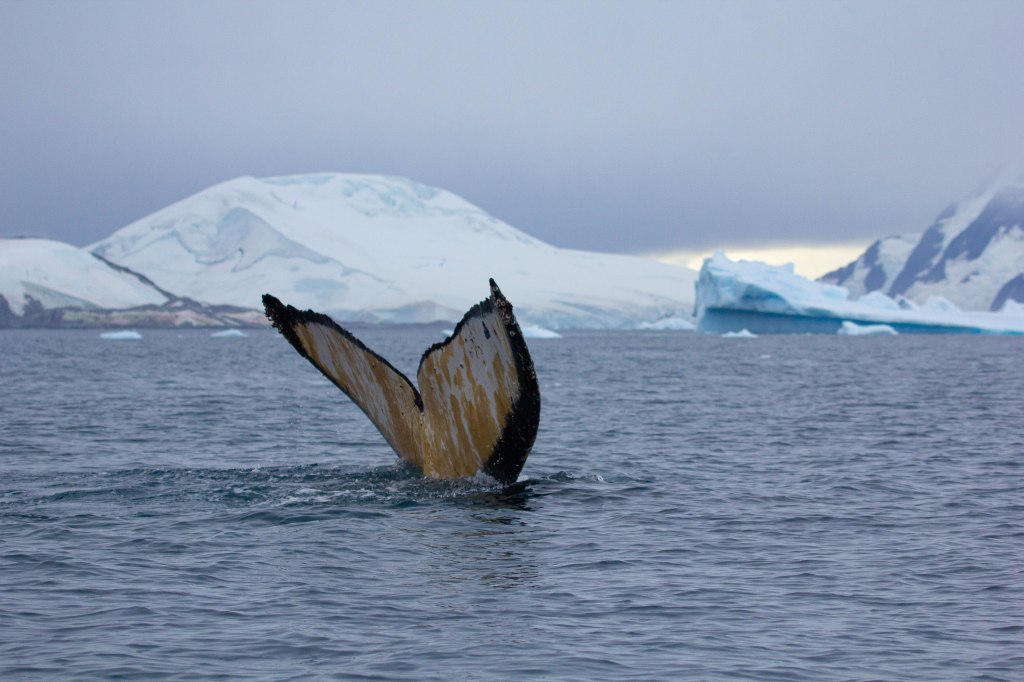
As for the blue, it has taken longer for these magnificent animals to return to South Georgia. Between 1998 and 2018 dedicated surveys off South Georgia recorded one blue whale sighting. Encouragingly in February 2020 58 blue whales were sighted. It is suspected that this slow recovery is down to a loss of cultural memory that this area is a foraging ground, and it is only now being rediscovered.
With increasing whale populations and increasing pressures on the marine environment, from climate change, krill fisheries, noise and vessel strikes to name a few, it is more important than ever to monitor these whale populations and understand their distribution and abundance.
Collisions with vessels is known to be a major threat to large whales, with larger vessels travelling at speeds of 14 knots or more posing an increased risk of any collision being fatal. As with most things in this world, there is no one universal solution to the problem of vessel strikes, but there are ways we can reduce the risk and one of those is to slow vessels down. Reducing speed to 10 knots or less is a key mitigation method with the probability of a strike being fatal significantly reduced at these slower speeds.
With the increase in vessels travelling to South Georgia and Antarctica and with populations of large whales increasing, it is now more important than ever to know where high densities of whales are. Already speed restriction areas (of 10 knots or less) have been implemented around South Georgia and in what are known as geofenced areas around the Antarctic Peninsula. The research project being run by ORCA is feeding directly into this.
All very interesting but where do I fit into all of this? Well, remember that young girl dreaming of Antarctica? She only went and got invited to take part in the project this year! February 2026 saw me leave the dreary wet weather of England and fly down to Punta Arenas in Chile to join HX’s MS Fram and set off on this very route, heading for the Falklands, South Georgia, the Antarctic Peninsula and the back across the notorious Drake’s Passage to Chile. What an absolute privilege to be invited to take part and to be given the opportunity to fulfil that lifelong ambition and dream of visiting this stunning part of our world.
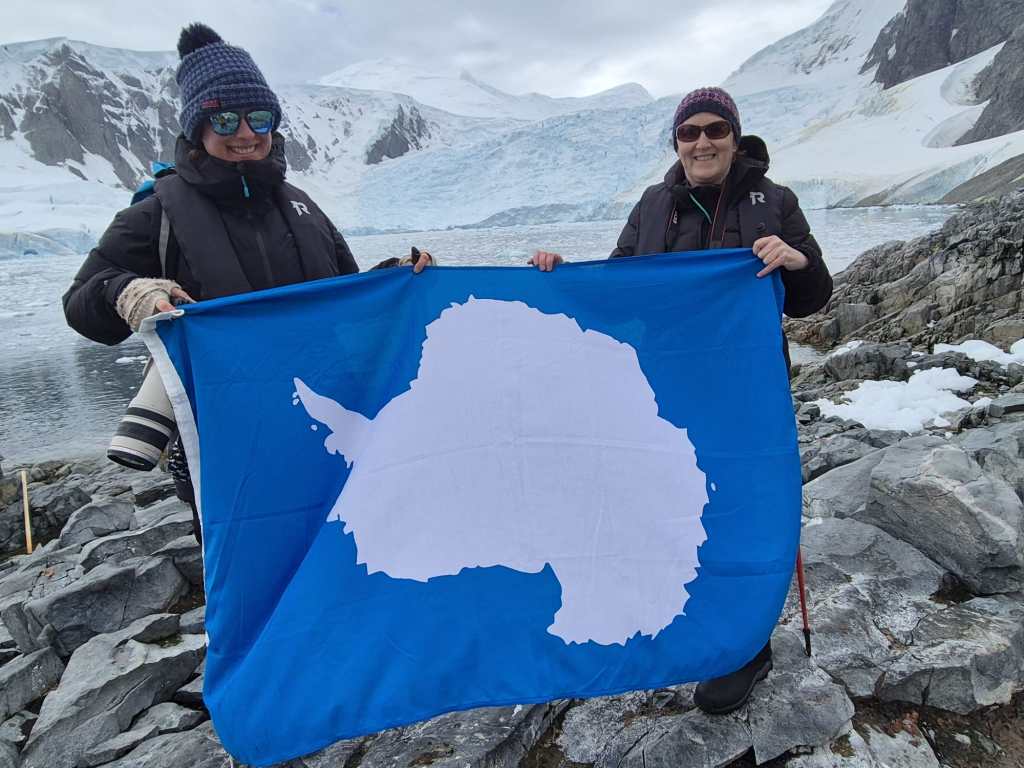
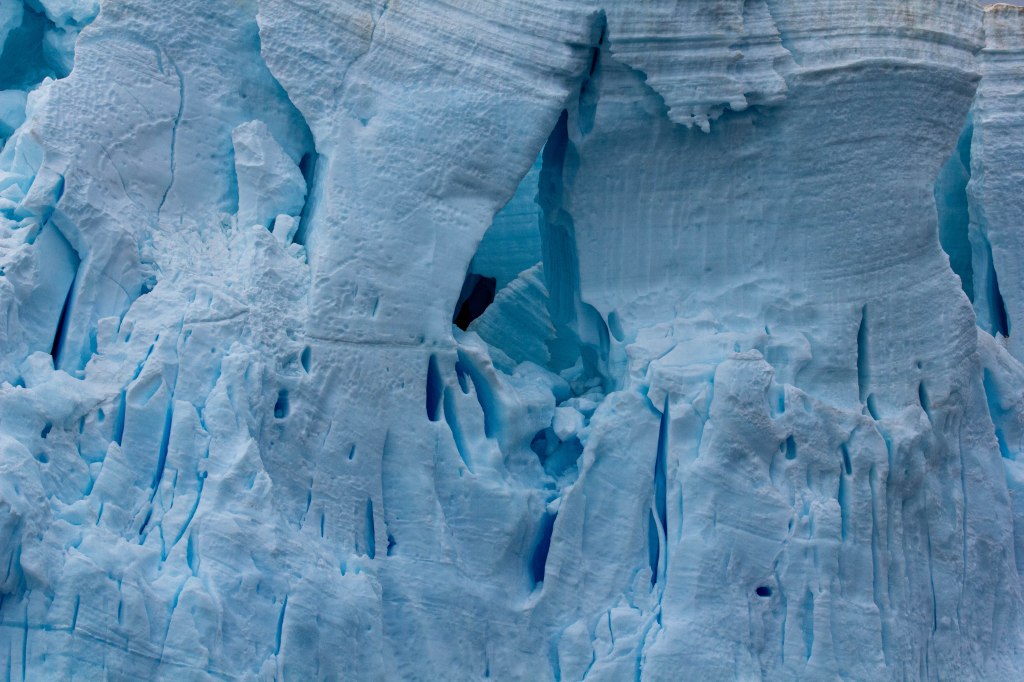
21 days later and we had spent over 55 hours surveying from the bridge and at least a further 14 hours surveying from the outside decks using the ORCA OceanWatchers App. We had recorded 86 sightings and 158 Individual cetaceans from the Bridge and another 36 sightings and 52 individuals from the deck. We had encountered humpback, sei, fin southern right whale and the largest of them all the mighty blue whale. We had seen dusky, Peale’s and hourglass dolphins. And that’s not to mention the thousands of penguins, fur seals, sea lions, seals, seabirds, waders, ducks, geese, passerines, Caracaras, that we were immersed in. All surrounded by an ocean that was at times stormy and restless, and others serene and calm, mountains rising to the clouds, immense glaciers flowing in slow moving rivers between them, ice bergs the size of buildings and in every shape imaginable, white but with such blues I have never seen before, from ice blue to deep cobalt blue.
It was an experience of a lifetime in such an immense and beautiful place that I cannot do it all justice in one post. My hope is to write and post photographs from the trip in a series of posts… how many? We shall see 😉
Reading list:
Vanderlaan & Taggart. 2007. Vessel collisions with whales: The probability of lethal injury based on vessel speed. Marine Mammal Science, 23(1): 144-156. https://onlinelibrary.wiley.com/doi/abs/10.1111/j.1748-7692.2006.00098.x
Calderan, S.V., Black, A., Branch, T.A., Collins, M.A., Kelly, N., Leaper, R., Lurcock, S., Miller, B.S., Moore, M., Olson, P.A., Širović, A., Wood, A.G. and Jackson, J.A. 2020. South Georgia blue whales five decades after the end of whaling. Endangered Species Research, 43: 359-373. https://www.int-res.com/articles/esr2020/43/n043p359.pdf
Redfern, J.V., Hodge, B.C., Pendleton, D.E., Knowlton, A.R., Adams, J., Patterson, E.M., Good, C.P. and Roberts, J.J. 2024. Estimating reductions in the risk of vessels striking whales achieved by management strategies. Biological Conservation, 290: 110427. https://www.sciencedirect.com/science/article/pii/S0006320723005281

