It had taken 36 hours of travelling. A train from Thetford to Heathrow. A 15 hour flight to Santiago in Chile. Leaving the mizzle of a wet English winter (seems like an age ago but remember the beginning of the year and the relentless rain?) and arriving in the heat of South America. A long wait in the lobby of a hotel near the airport, making the most of the cool interior before another 3 hour plus flight to (almost) the bottom of the Continent. It was dark when we arrived in Punta Arenas. Gone midnight local time. Just the twinkling lights of a city port rushing past the taxi window, barely able to keep eyes open now. The little air B&B was tucked away up a side street, through a gate. The grateful embrace from a warm soft bed now the only thing on our minds.
The morning revealed metal roofs, a tall bushy tree overlooking a little patch of grass and a small carpark. Beyond, a slither of water, the Strait of Magellan. On the far side the hint of hills. The sea was serenely calm. A silver ribbon reflecting the cloudy blue sky. A ship sat at anchor and I could swear I saw dark shapes leaping. Dolphins perhaps.
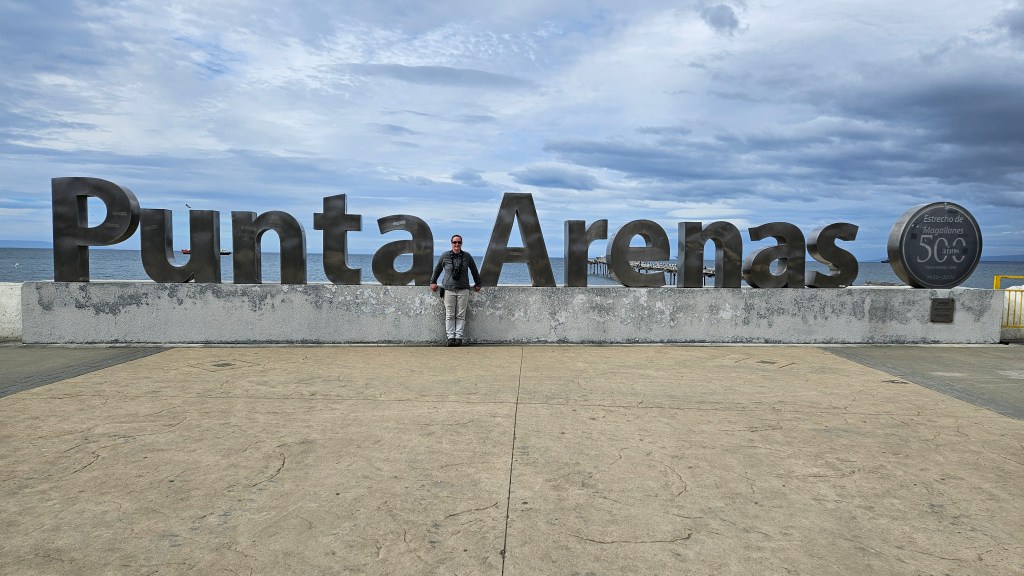
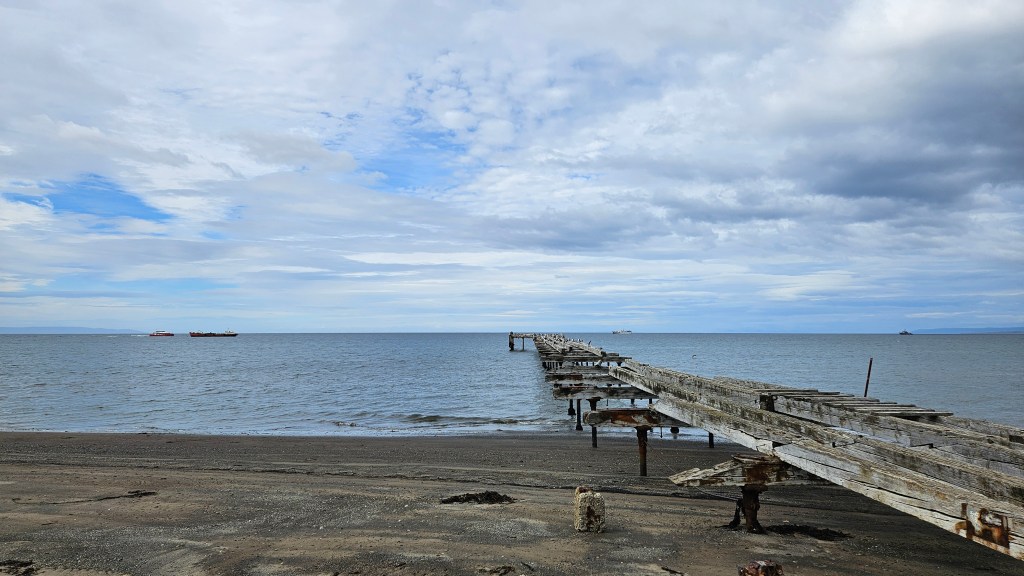
We spent the next day having a little explore. The Costanera del Estrecho, the waterfront promenade stretches along the city’s sea front, with sweeping views of of the Strait. The hills beyond, the Tierra del Fuego were a mere shadow on the horizon. This panoramic view was topped by a sky full of clouds and patches of light blue. The sea remained silvery, a cold metallic greyish blue, smooth with a few ripples. It rolled gently onto a stony sandy strip of beach before meeting the paved promenade. Where we stood there are the customary large letters spelling out the name of the city, with the backdrop of the Strait. I could not resist a picture. There were statues, sculptures and monuments celebrating the city’s rich maritime history. An old dilapidated and collapsing wooden pier stretched dead straight into the water. It is no longer used by humans, with the purpose built port and pier where industry and cruise ships moor side by side. The Muelle Loreto, originally built for coal shipments, now claimed by birds. Hundreds of Imperial cormorants and rock shags perch on its weathered wooden beams. Squadrons of them swoop down to the water, congregating in its vicinity, floating, diving in search of food. Sitting on the water were also Southern giant petrels and kelp gulls. Terns and waders sit and dart along the shore, and the seemingly ubiquitous house sparrow flit in the long grasses at the back of the beach.
We took it easy for the day. Meandering along the promenade, and then back to the house, buying some supplies and soaking in the local chatter over dinner.
Before we knew it we were back at the main port the following morning, luggage in hand, walking along the busy pier. Large cruise ships were moored alongside. Supplies were being loaded by various vehicles, people bustled everywhere. Passengers from one large cruise spilled out onto the pier and were loaded into coaches ready to explore the city. We continued down the pier, weaving in and out of the hustle and bustle, to the second to last ship on the left. A smaller cruise ship by comparison. And there she was, the MS Fram. There was also a hive of activity around her as she prepared for the next trip, the next load of passengers that would include us as Guest Scientists on behalf of ORCA.
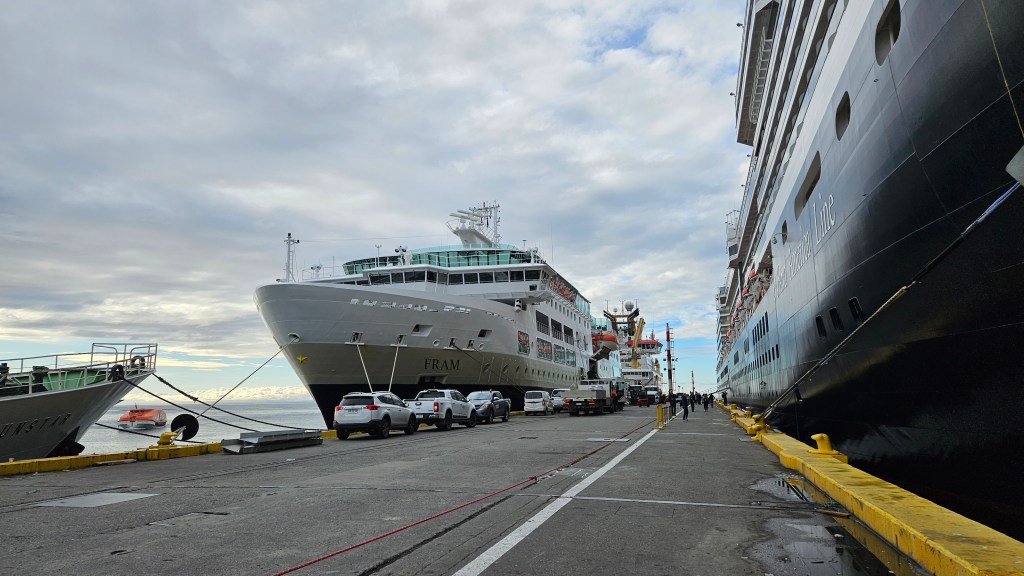
We climbed up her gang way and on board, meeting the previous ORCA team on the way. We had a coffee, a biscuit and a brief tour while doing a handover and briefing. It was at this point we realised the ship moored behind us was none other than the RSS Sir David Attenborough! An iconic ship named after an iconic stalwart of natural history. The RSS Sir David Attenborough, a floating laboratory conducting science at sea as well as proving logistical support to the British Antarctic Survey research bases. It was therefore an absolute treat to be invited on for a tour along with the MS Frams Expedition Team. We could hardly believe our luck at being given the opportunity to look round this renowned ship.
Before long we had hugged our colleagues goodbye, and were settling into our compact but cosy cabin on board the MS Fram. The passengers were arriving and we were going through the final preparations for leaving. As the evening drew on MS Fram slipped her moorings and began motoring out into the Strait.
The MS Fram is a lovely ship. Big and luxurious enough to not feel like you are roughing it, it is an Expedition Cruise after all, but small and intimate enough to not get lost, to feel connected to the passengers, crew and ocean. As an Expedition Cruiser she focuses on immersive experiences, driven by exploration, science and discovery, heading to some of the wildest and remotest places. And they don’t get much wilder or remote as South Georgia and Antarctica.
We were still motoring through the Strait as evening drew on and whales started to appear. The sky filled with a blaze of colour over the retreating land, forming a stunning backdrop to the tall blows of sei whales. As darkness fell it is was with much anticipation of the morning that we headed to bed in our small but cosy cabin.
Sunrise from the bow on Deck 5 revealed no land in sight, and a calm, untroubled South Atlantic Ocean stretching to the horizon. The hazy blue sky merged with a serenely bluish grey ocean that held but a few ripples.
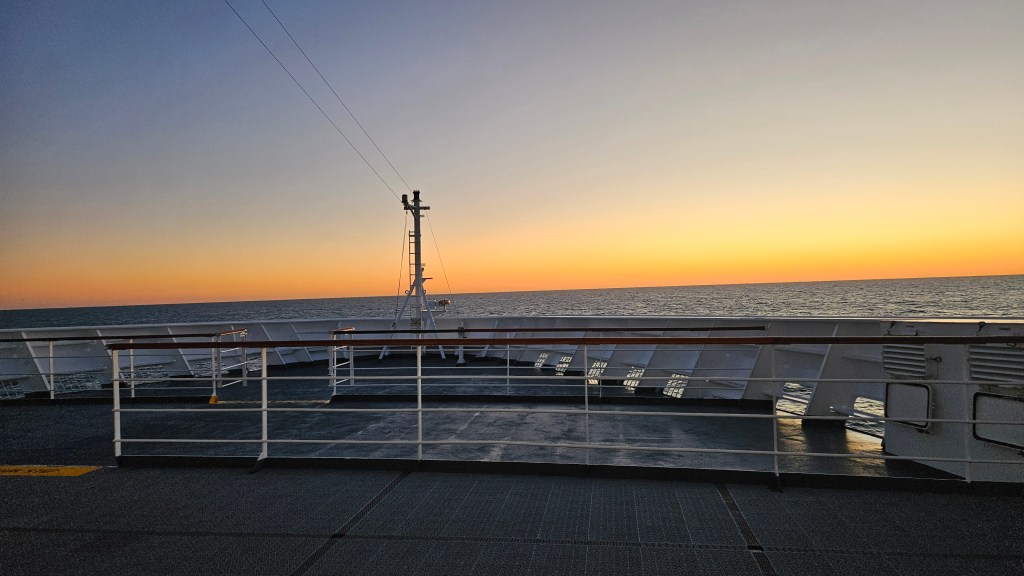
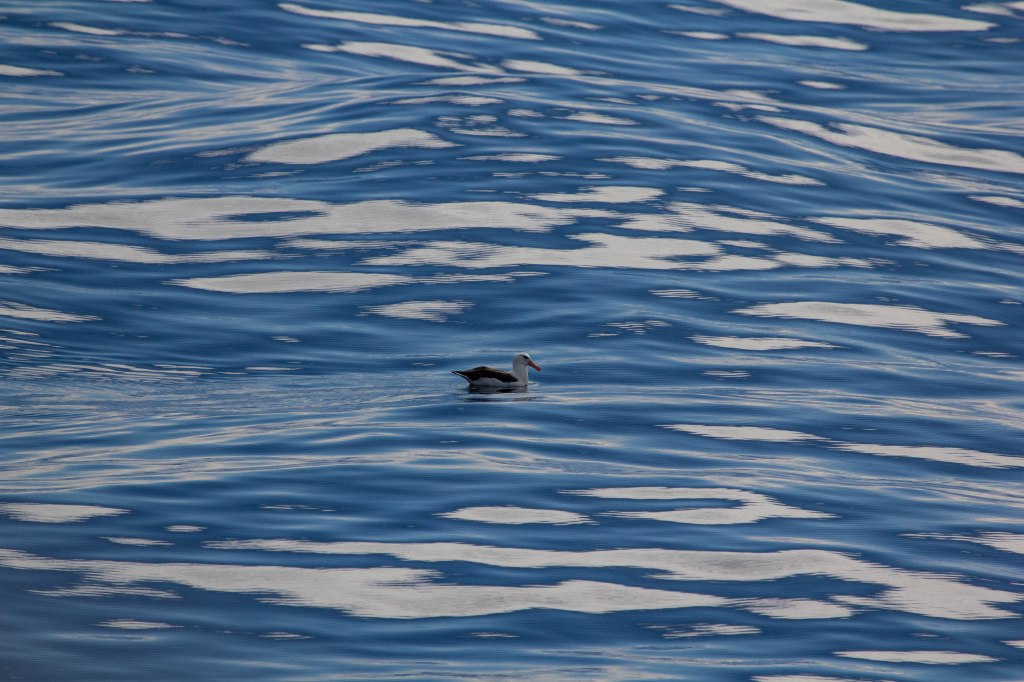
At first I was the only one on deck, taking in the serene calm. Giant birds glide past catching little uplifts of breeze before almost giving up as the day progressed and the wind dropped even further. Black-browed albatross, giant petrels, white-chinned petrels, great shearwaters, sooty shearwaters, slender-billed prions, Southern Royal albatross all effortless in their flight. Common diving petrels and Magellanic penguin’s pop up alongside as the ship eased by, before skittering off or diving under the blue.
I saw more tall blows, either sei or fin whales. A few surfaced closer giving me wonderful views of long dark backs and tall and swept back dorsal fins. In the distance near to the horizon I caught a glimpse of a back and tail fluke, a humpback? or maybe a Southern right whale? That would be a first for me, but I don’t see the animal again and so it remains a mystery. I see the flurry of white water as dolphins zoom past, too quick to catch sight of properly. And then out of the smooth blue water a huge blow and back appeared. I took a second and looked to the passenger standing next to me. There were only four of us on deck. Myself, two passengers and a member of the Expedition Team. Everyone else was either on another part of the deck or inside, perhaps thinking we were not yet in an exciting wildlife watching area…
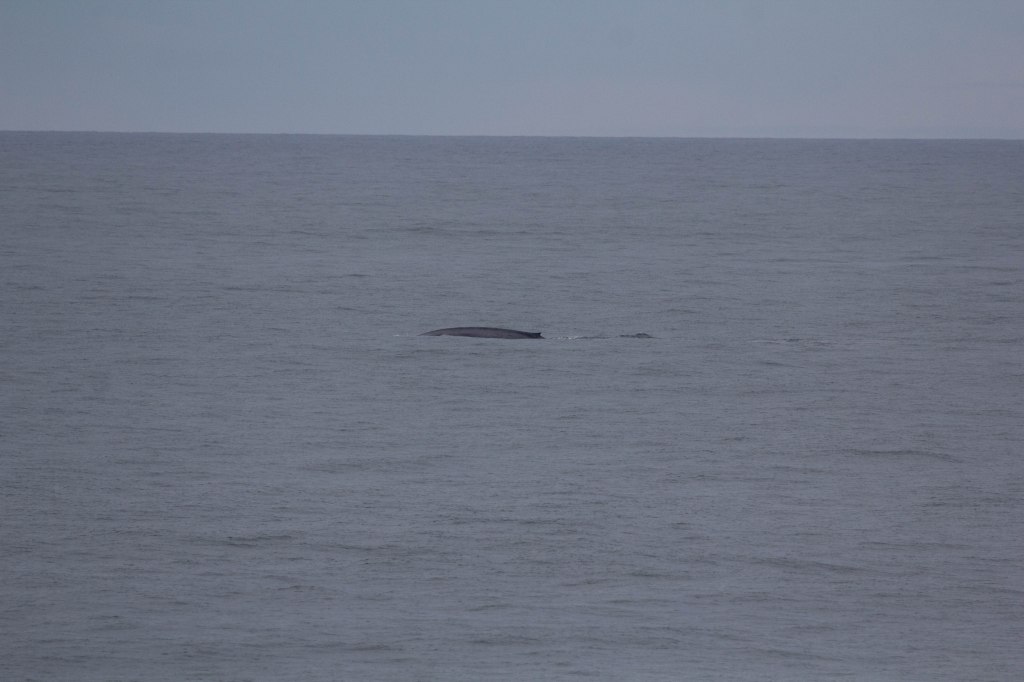
I looked back, and this huge animal surfaced again. I was ready with my camera this time. Clicking away as the whale surfaced leaving a huge ‘fluke print’, the bubble of water left at the surface as a whale dives. Things were clicking into place in my brain, large blow, huge body, bluish grey colour, small dorsal fin. There is nothing else this animal could be than the largest animal on our planet. The blue whale. Excitement rushed through me, spilling over into an excited babble to those on deck. We messaged the Expedition Team WhatsApp, and a few more people spilled out onto the deck, but the whale was moving behind and beyond us now. There was a lot of discussions as we described what we saw, some disbelief and doubt, as we were not in a known blue whale area. But there was a little kernel of strong belief in me in what I saw. It was too big, too bluish and with such a small dorsal fin to be anything else. Reviewing my photographs on my laptop later only strengthened that belief. But to be sure. To be absolutely sure. I emailed the images back to ORCA HQ (the wonders of modern technology and StarLink meant we were never without internet access). In the scheme of things it did not take long for them to come back. They had shared the images with local experts and it was conclusive. A blue whale. Most likely an Antarctic blue whale on its migration north rather than a Pygmy blue that tend to remain around the continent. The results from the experts was that it is thought to be the first encounter with an Antarctic blue in that area, and while perhaps not completely unexpected in terms of migration routes it is an unusual sighting.
I couldn’t quite believe it. First full sea day and there I was in glassy smooth conditions in the South Atlantic Ocean watching the worlds largest ever animal. And we hadn’t even got to the ‘wildlife hot spots’ yet! There was so much more to come…